US, UK, Canada and Australia travel advisories for Albania compared, with what each warning means in daily life, from a local's point of view.
Quick answer: Official travel advisories for Albania are moderate, and they differ mainly in tone. As of October 2026, Canada says "Take normal security precautions" (its lowest level), the United States rates Albania Level 2 "Exercise Increased Caution" because of crime, Australia says "Exercise a high degree of caution" because of limited healthcare options, and the UK gives detailed advice without an overall level. None of them advise against travel to any part of Albania. The practical risks they share are road safety, petty theft, earthquakes and summer wildfires.
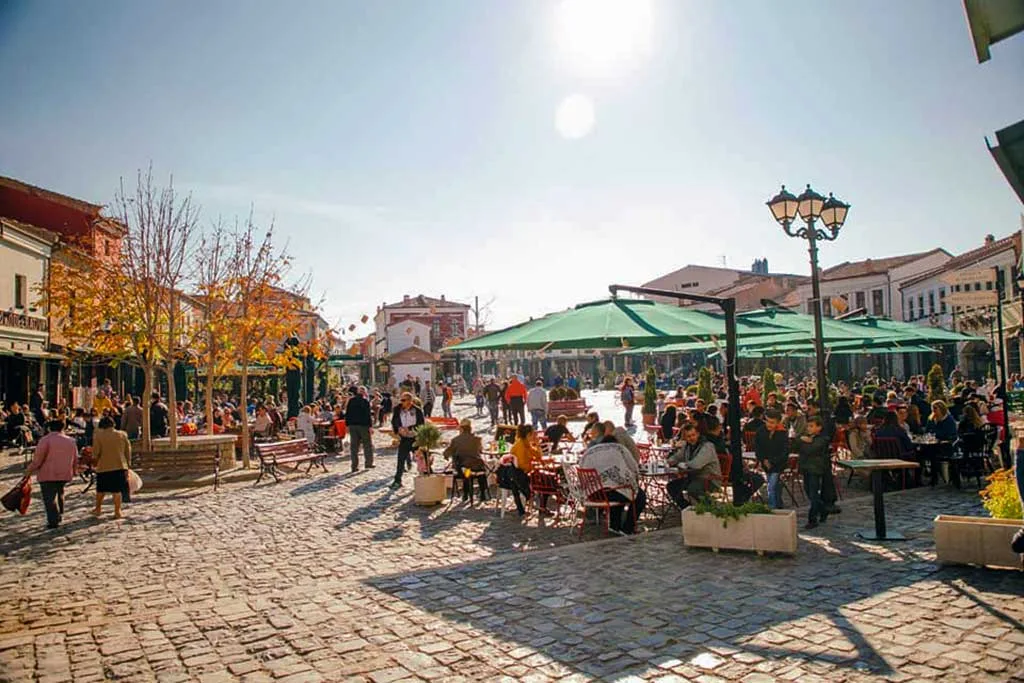
I travel often to Korçë. The Old Bazaar of Korça is my favorite place to hang out for a coffee and meet people, and over the years I have met quite a few travelers there who almost canceled their trip the night before their flight. They had read an advisory, seen the words "Level 2" or "high degree of caution", and imagined something serious. Then they look around: grandparents playing dominoes, children running between the tables, a waiter bringing a plate of petulla, our fried dough, because it is their first morning in town. "This is Level 2?" they ask me, half laughing. Yes, it is, and both the label and the reality are true. You just need to know how to read one against the other.
So this article is a comparison: on one side, what four governments write about Albania; on the other, what I see every day as someone who lives here. I have no interest in hiding problems, because a guest who is well informed is a happy guest. Read through, and you will understand the advisories better than most travelers who quote them.
Each government uses its own scale, and the same words do not mean the same thing everywhere. The United States uses four levels, from Level 1 "Exercise Normal Precautions" to Level 4 "Do Not Travel". Canada and Australia also use four steps, from normal precautions to "avoid all travel" or "do not travel". The UK does not give a single score; instead, it lists specific risks and only advises against travel to areas where it sees a serious danger.
The important point is this: Albania sits at the lowest or second-lowest step on every scale, and no government advises against travel to any region of the country.
Keep one more thing in mind: government advisories are quite often outdated. Updating them takes time and money, so a page may describe the situation from a year or two ago. The US advisory for Albania, for example, was last updated on 31 December 2024. Always check the date at the top of the page, and compare it with recent local information.
| Government | Overall advice | Main reason given |
|---|---|---|
| Canada | Take normal security precautions (lowest level), updated 26 May 2026 | General precautions; petty crime in crowded places |
| United States | Level 2: Exercise Increased Caution, last updated 31 December 2024 | Crime, including targeted violence linked to organized crime |
| Australia | Exercise a high degree of caution, updated 22 July 2026 | Limited healthcare options |
| United Kingdom | No overall level; detailed risk advice, updated 13 August 2026 | Road safety, street crime, earthquakes, global terrorism threat |
Notice something interesting: four governments, four different main reasons. That alone tells you that Albania is not one big danger, but a country with a few specific, manageable risks.
What they write: The US says there has been "targeted violence associated with illicit drug networks and organized crime countrywide", and that police capacity is limited in remote regions. Canada notes that organized-crime violence does not typically target foreigners. The UK says reports of crime targeting foreigners are rare, and warns about pickpockets in tourist areas, on buses and at transport hubs.
What I see: Albania, like many European countries, has criminal groups who settle scores with each other, and Albanians are the first to complain about it in the cafés. But those incidents are aimed at rivals, not at visitors eating fërgesë in Tirana or hiking to the Blue Eye. In reality, foreigners rarely encounter any real safety problem here.
Petty crime is also lower than many travelers expect. In Numbeo's 2026 Crime Index for European cities, which is based on residents' and visitors' perceptions, Tirana scores 39.8, a lower (safer) rating than Rome (47.3), Barcelona (51.9), Brussels (55.4), London (55.6) and Paris (58.0). Those are wonderful cities, and the point is not to compare anyone unfairly; it is simply that Albania rates safer on this measure than many of Europe's most visited capitals. Normal city sense, such as keeping your phone off the edge of a café table, is still a good habit.
When visitors do run into trouble in Albania, it is often caused by a misunderstanding rather than by crime. One example I see is the way people approach women in bars and social places. In Western Europe, the US, Canada or Australia, a loose, persistent approach – insisting on buying drinks, nagging after a polite no – may be shrugged off. In Albania, the same behavior can lead to real problems. Moral values are strong, and by tradition local men, especially when they are present, feel an obligation to "protect" a woman they believe is being bothered.
The other side of this coin is beautiful. Respect stands very high in Albanian culture. When you show respect, or even simply try to respect local customs – greeting people, accepting a coffee, dressing modestly in churches and mosques, asking before taking photos of people – it is received with exceptional hospitality and appreciation. I always advise visitors to take a little time to familiarize themselves with the local culture before they arrive. It is the best safety tip I know.
Many travelers still ask me about blood feuds, because older articles and films made them famous. None of the four advisories I compared mentions them today. The Kanun of Lekë Dukagjini, the old customary law of the northern highlands, did regulate revenge between families, but the same law also made the guest sacred. Under the Kanun, harming a guest was one of the worst dishonors a family could suffer, and the word of honor, besa, protected strangers on the road.
In Shkodër, people tell the legend of Rozafa Castle to explain how seriously Albanians take a given word. Three brothers building the castle walls, which collapsed every night, were told by a wise old man that they must wall in a woman to make them stand. They promised one another, on their besa, not to warn their wives, and the wife who brought them lunch the next day would be sacrificed. The two older brothers broke their word and warned their wives in secret. Only the youngest kept his besa, so his wife Rozafa came with the food. She accepted her fate, but asked them to leave her right eye, right hand, right breast and right foot outside the wall, so she could still see, caress, feed and rock her baby son. Mothers in Shkodër still say that the water seeping from the castle stones is Rozafa's milk. It is a legend, of course, but it explains why a promise here still matters.
What they write: The UK calls driving "very hazardous and often aggressive and erratic", and notes that road deaths are among the highest in Europe. Canada and Australia warn about poor secondary roads, livestock, farm vehicles and poor lighting, especially in the mountains of the north and southeast.
What I see: In 2026, the vast majority of Albanian roads drive normally, and the main routes are in far better shape than many advisories suggest. The real habit to expect is being overtaken on bends, so keep to your lane, slow down before curves and let impatient drivers pass. A few roads need extra attention this year:
The roundabout rule, Albanian style. The normal rule is the same as in the rest of Europe: traffic already in the roundabout has priority, and you must yield before entering. In normal conditions, always follow this rule. The practical exception is in congested city traffic, for example in central Tirana at rush hour. There, if you wait for a completely free gap, you will never get your turn, because the traffic is so dense. Local drivers ease slowly into the roundabout, yielding for safety but keeping the car moving, and the others make room. Do the same: move slowly and predictably, make eye contact, and never force your way in fast.
Mountain roads to Theth, Përmet or the Llogara Pass are beautiful but demand patience. Avoid them at night, and add some extra time to every journey that Google Maps calculates.
Australia's main reason for its caution is limited healthcare options, and this is fair. Public hospitals outside the big cities are basic. In Tirana, private hospitals offer good care, but you pay upfront and claim back from your insurance. My advice: buy travel insurance with medical cover, keep your policy number in your phone, and remember the local emergency numbers, which work more reliably than the general 112: 127 for an ambulance, 128 for the fire service and 129 for police.
The UK, Canada and Australia all say terrorist attacks "cannot be ruled out" or could happen. Read carefully, though: this is standard wording they use for most European countries. Australia notes there have been no recent attacks in Albania. Albania is a country where Muslims, Orthodox and Catholic Christians, and the Bektashi live side by side and celebrate each other's holidays, a harmony we are very proud of.
Albania is not in the Schengen area, so the EU's Entry/Exit System does not apply at Albanian borders, although you may meet it if you travel on to Greece, Italy or Montenegro. US citizens may stay in Albania for up to one year without a residence permit, according to the US State Department. Most travel insurers continue to cover destinations at the lower advisory levels, but always read your policy, because some exclude areas where your government advises against travel. For Albania, that is currently nowhere.
For everyday safety questions, from solo travel to tap water, read my earlier article Is Albania Safe to Visit?. If you are visiting the north, my Shkodër guide tells the full story of Rozafa Castle, and the Korçë guide will take you to the Old Bazaar where this article began.
The US State Department rates Albania Level 2, "Exercise Increased Caution", because of crime. It last updated the advisory on 31 December 2024 and does not advise against travel to any region.
No. The UK Foreign Office gives detailed advice on road safety, street crime, earthquakes and terrorism, but does not advise against travel to any part of Albania.
Australia's Smartraveller gives limited healthcare options as the main reason. Travel insurance with medical cover is strongly recommended for every visitor.
No. None of the US, UK, Canadian or Australian advisories mention blood feuds, and the old customary law of the north, the Kanun, treated guests as sacred.
An advisory can tell you what to watch for, but only a visit can show you how Albanians live. Let our audio tours of Albania walk with you through Shkodër, Korçë, Berat and beyond, with the stories behind every castle wall. Discover more practical guides on our blog, and if something in an advisory still worries you, ask me directly. I would rather answer your question today than have you miss Albania tomorrow.
Written by A Hila
How it works
Plan Your Visit to Albania
Choose how you want to explore
Listen to this destination's audio tour free — or book a private guided experience.
Open Audio Tour Book a Guided Tour