Korçë travel guide: Mirahori Mosque (1484), 1916 Autonomous Republic, National Museum of Medieval Art (700 Lek), Birra Korça brewery, lakror pie.
Korçë sits on a 850-metre highland plateau in south-eastern Albania (population 51,152) and was, for one extraordinary year, a French-protected republic. The town was founded in 1484 by the Ottoman governor Ilias Bey Mirahori, who had received seven villages from Sultan Bayezid II as a reward for service. He built the Mirahori Mosque the same year — the second oldest mosque in Albania and still standing. Korçë is 167 km / 2.5–3 hours from Tirana, just below the North Macedonia and Greek borders.
On 10 December 1916, with the central Albanian state collapsed under wartime occupation, the city's elite proclaimed the Autonomous Albanian Republic of Korçë under French protection, with Themistokli Gërmenji as president. It lasted 14 months — long enough to issue stamps, run schools in Albanian and serve, briefly, as the only functioning Albanian polity. A quarter-century later, on 8 November 1941, the Albanian Party of Labour — the future ruling Communist Party — was founded clandestinely in a Korçë house, with Enver Hoxha as one of the seven founding members.
Korçë's intellectual reputation goes deeper. The first Albanian-language school anywhere in the world, the Mësonjëtorja, opened here on 7 March 1887 — at a moment when teaching the Albanian language was illegal in the Ottoman Empire. The building still stands as a museum.
The Old Bazaar (Pazari i Vjetër), restored after 2015, is the city's centrepiece — cobblestone lanes lined with cafes, craft shops, restaurants and small hotels in restored Ottoman commercial buildings. It is free and open day and night. The Resurrection Cathedral on the central boulevard, completed in 1995 in neo-Byzantine style, is one of the largest Orthodox churches in the Balkans (free entry).
The National Museum of Medieval Art on Bulevardi Republika is one of the country's outstanding museums: more than 6,000 icons and ecclesiastical objects, including major works by Onufri and his school. Entry 700 Lek, open Tuesday–Saturday 09:00–16:00. Allow at least 90 minutes. Climb the Panoramic Tower of Korçë (50 Lek, 07:00–22:00 in summer) for the view across the plateau to the surrounding mountains.
The Mirahori Mosque (1484–1495) is open to non-prayer visits — please dress modestly, free entry. The Gjon Mili Photography Museum, dedicated to the Korçë-born American photographer who shot for Life magazine and pioneered stroboscopic photography (200 Lek, Tue–Sun 09:00–14:00 and 17:00–19:00), is a small but rewarding stop.
Korçë's table is distinct from coastal Albania. The signature dish is lakror, a thin layered pie traditionally baked under embers; the leek-and-gjizë (whey curd) and tomato-and-onion versions are the classics. Kernacka are the local skinny grilled meatballs, eaten with raw onion and bread. Flija, the layered crepe-like pancake usually associated with Kosovo, is also at home here.
Birra Korça is Albania's most famous beer — the brewery, opened in 1928, still operates in the city centre and offers tours and tastings. The Korçë plateau is also a serious red-wine zone, with strong reds based on Vlosh and Shesh i Zi grapes; ask at any bazaar restaurant for a local verë e kuqe.
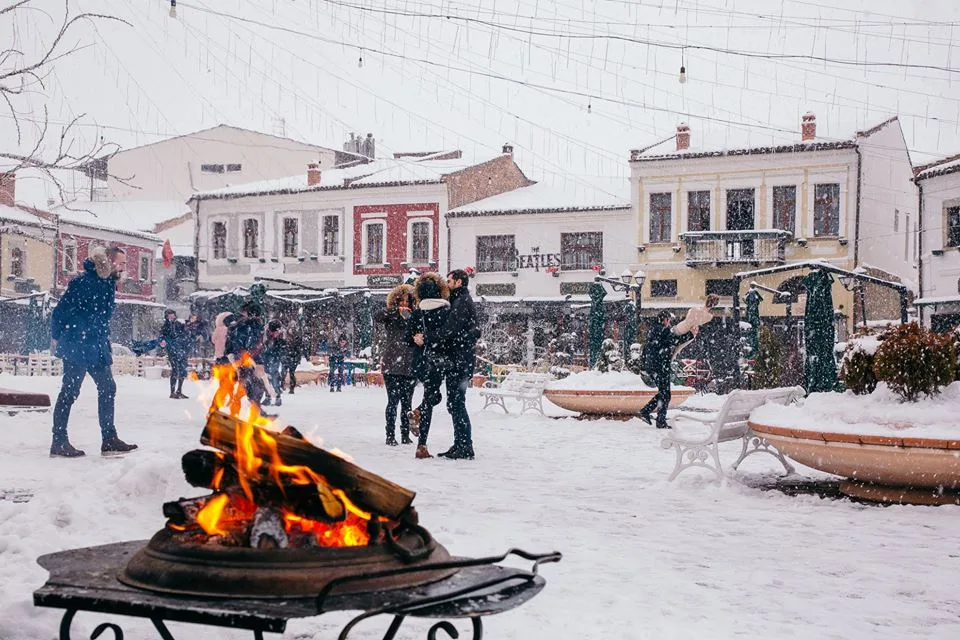
May and September–October are ideal — at 850 m the city is significantly cooler than the coast. July and August are pleasant by Albanian standards, around 23–28 °C. December's Christmas Bazaar has become a major Albanian winter event despite the often-snowy temperatures. From Tirana, drive 167 km / 2.5–3 hours via Elbasan and Pogradec; intercity buses run several times daily for around 700 Lek. Plan two days.
| City population | 51,152 (2011 census); 43,254 (2023 est.) |
|---|---|
| Elevation | 850 m |
| Founded | 1484 by Ilias Bey Mirahori |
| Distance from Tirana | 167 km / 2.5–3 hr |
| Medieval Art Museum | 700 Lek, Tue–Sat 09:00–16:00 |
| Panoramic Tower | 50 Lek |
| Recommended stay | 2 days |
Day trips from Korçë include Voskopoja (20 km, the 18th-century Aromanian merchant town with five surviving frescoed churches), Pogradec / Lake Ohrid (40 km), and Lake Prespa shared with Greece and North Macedonia. Albanian Eagle Tours connects all three on the 3-day Tirana–Berat–Korçë–Pogradec private tour; Korçë also works as the inland counterweight to a beach trip on the 5-day Riviera, Vjosa wild river and Lake Ohrid tour.
The 1916–1918 French protectorate and the strong French educational influence afterwards (the Lycée Français, opened 1917) gave the city a distinctly Francophile cultural layer that older residents still cherish.
Yes — guided brewery tours and tastings can be arranged through the central tasting hall. There is also an annual Birra Korça Festival in mid-August.
Two days is ideal: one for the bazaar, museums and brewery, one for a Voskopoja or Pogradec day trip.
Possible but rushed at 5–6 hours of round-trip driving. Stay overnight if you can; the bazaar at dusk is the best time of day.
On 7 March 1887, in a quiet Korçë house belonging to Diamanti Terpo, the first school in the world to teach exclusively in the Albanian language opened its doors. Teaching Albanian was illegal in the Ottoman Empire at the time — the language had no recognised national status, and texts in Albanian using any of the three competing alphabets could lead to arrest. The Mësonjëtorja's first teacher was Pandeli Sotiri; among its earliest students were figures who would later shape independent Albania. The original building still stands as a museum on Rruga Pandeli Sotiri (modest entry, daylight hours). Korçë's intellectual confidence in 1887 — and the willingness of local families to risk Ottoman reprisal — set the tone for what came next.
Twenty kilometres west of Korçë, the village of Voskopoja was, in the 18th century, one of the largest cities in the Balkans — a Vlach (Aromanian) merchant centre with reportedly 20,000–60,000 inhabitants, the second printing press in the Ottoman Balkans (1731), and an academy producing scholars across the empire. Twice sacked (1769 by Ali Pasha's predecessors and 1788 by Ali Pasha himself), the city collapsed and never recovered. Five frescoed churches survive — Saint Nicholas (1721, with 18th-century frescoes), Saint Athanasius, the Prophet Elijah, the Theotokos and Saint Michael — and a handful of guesthouses now operate in restored stone houses. A morning trip from Korçë covers the major churches; bring small change for the keepers.
Founded in 1928 in the early years of independent Albania, Birra Korça is the country's oldest beer and most-recognised brand. The brewery in the city centre offers tours and tastings on request; the annual Birra Korça Festival in mid-August is one of the biggest summer events in southern Albania, drawing crowds for a week of music and beer in the city's central park. The brewery also produces a darker, stronger seasonal beer that is often available only on tap in Korçë.
The Old Bazaar, Medieval Art Museum, Birra Korça brewery, the Mësonjëtorja, the photography of Gjon Mili — all of this needs context to make full sense. Korçë's combination of late-Ottoman provincial life, French protectorate Francophilia (1916–1918), and intellectual prestige (the 1887 school, the 1941 founding of the Albanian Communist Party) makes it the most layered small city in Albania. Albanian Eagle Tours' 3-day Tirana–Berat–Korçë–Pogradec private tour includes Korçë with a guide who can read both the Albanian-only museum captions and the wider regional history.
Korçë sits at 850 metres on a highland plateau and gets reliable winter snow — December and January temperatures often run -5 °C to +5 °C with multiple snowfalls per year. The annual Korçë Christmas Bazaar in December has become one of the largest winter events in the country, with wooden chalets, mulled wine, traditional music and crafts filling the central park for most of the month. The nearby Voskopoja village holds a small ski area suitable for beginners; more serious skiing is in North Macedonia or Kosovo. Winter visitors should pack proper cold-weather clothing — most foreigners underestimate how cold the Korçë plateau gets compared to the much milder Adriatic and Ionian coasts.
Visit Korçë on a private route. Book the 3-day Tirana–Berat–Korçë–Pogradec tour with Albanian Eagle Tours.
🗺 East Albania — Explore Nearby
Each destination is reachable by private Car & Driver from Tirana. View all organised tours →
Plan your visit to Korçë
How it works
Plan Your Visit to Albania
Choose how you want to explore
Listen to this destination's audio tour free — or book a private guided experience.
Open Audio Tour Book a Guided Tour