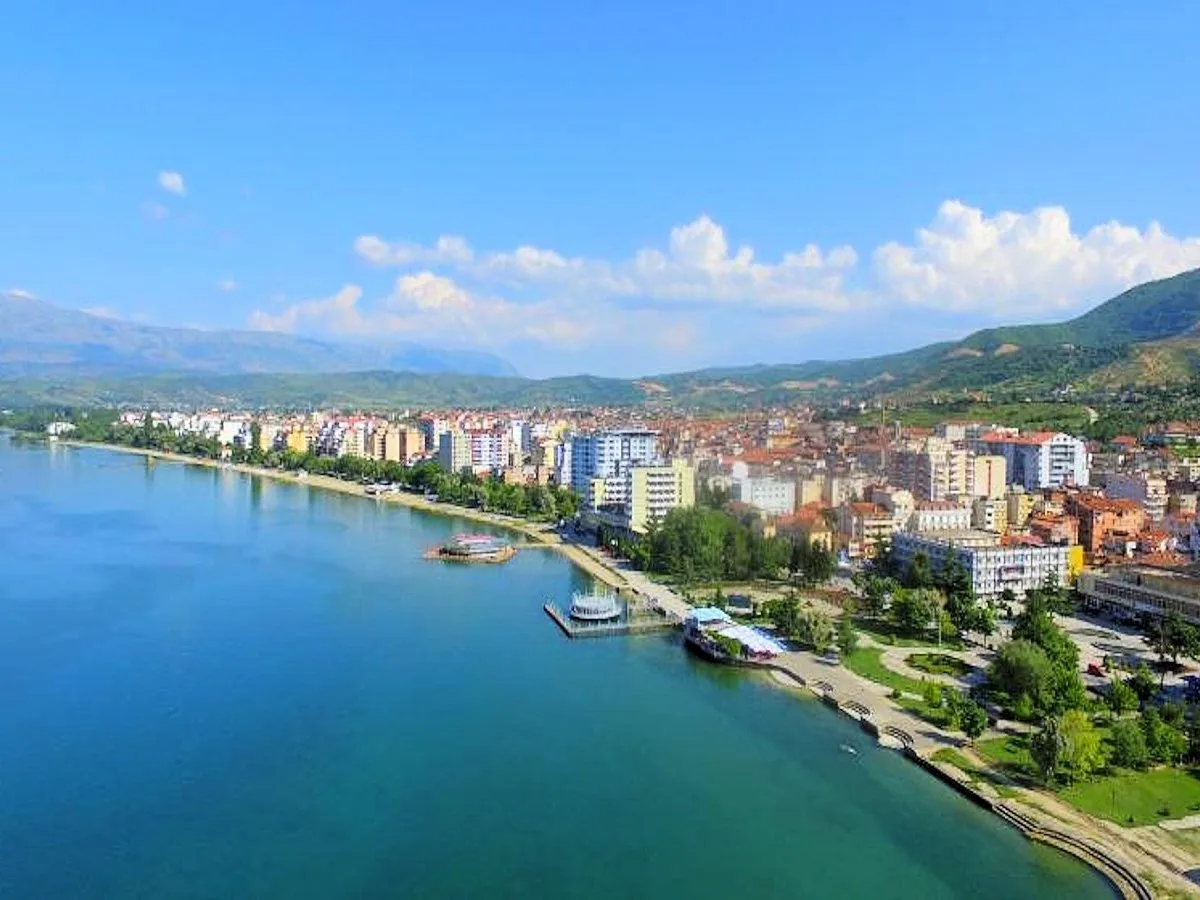
Pogradec & Lake Ohrid (UNESCO 2019): koran trout, Drilon park boats (~€5), Lin pile dwellings, Selca Illyrian tombs and 8,500-year-old prehistory.
Lake Ohrid is between three and four million years old — one of the oldest lakes on earth — and 124 km / 2–2.5 hours east of Tirana its Albanian shore is anchored by Pogradec (population 17,371). The Albanian side joined UNESCO's Natural and Cultural Heritage of the Ohrid Region in 2019, decades after the North Macedonian side, and 8,500-year-old pile-dwellings discovered near Lin make it the oldest known stilt-house settlement in Europe — predating its Swiss equivalents by more than 2,000 years.
The Lin Peninsula pile-dwelling site, excavated since the 2010s by an international team, is dated to roughly 6,500–6,000 BC, making it Europe's oldest known pile-dwelling settlement and a keystone in our understanding of how agriculture spread northward through the Balkans. Pogradec Castle, on the hill above the modern town, was destroyed by fire in the late 2nd century BC during the Illyrian-Roman-Macedonian wars, rebuilt under Rome and finally destroyed by Slavic invaders in the 9th century AD. Ottoman traveller Evliya Çelebi described Pogradec in 1662 as a city with 600 houses, 150 shops and four mosques.
The town's most important modern moment came on 14 March 1887 when the second Albanian-language school in the country opened here — three years after the first in Korçë. The lake itself drains into the Drin via the underground Drilon springs.
Walk the 5 km lakeside promenade — built up after 2015 with cafes, cycle path and viewing piers — and swim from Pogradec Beach (free, sandy). Five kilometres east of town, Drilon National Park is the lake's most photographed corner: still emerald springs, weeping willows, footbridges and quiet swans. Entry is free; small wooden boats ferry visitors across the springs for around €5; daylight hours.
For a half-day excursion north, the Lin Peninsula (35 km north along the lake) offers the prehistoric stilt-house museum experience, a 6th-century basilica with surviving floor mosaics, and a small fishing village with restaurants. Boat tours from Pogradec or Tushemisht run €10–30 per person depending on group size. Inland, the Illyrian Royal Tombs of Selca (4th–3rd century BC, 40 km west) are a remarkable rock-cut necropolis; the trip is usually done as a guided day with car for around €40.
South of Pogradec, take a boat to Maligrad Island on Lake Prespa to visit the 14th-century cave church of St. Mary, accessed from the village of Tushemisht.
The lake's signature fish is koran, a brown-trout endemic to Lake Ohrid (Salmo letnica). Order it grilled or, more rarely, as tartare; expect around €10 per plate at lakeside restaurants. The fish is protected and seasonal — eat it in spring and autumn rather than peak summer. The local wine, made from Serini grapes grown on the lower slopes of Mali i Thatë, is fresh and aromatic; the small Grabovac Winery hosts tastings on request. Round off with rakia made from local mulberries.
May–September is the swimming season, with daytime highs of 25–35 °C in July and August. Spring and early autumn are best for cooler walks and boat trips with fewer crowds. From Tirana, the drive is 124 km / 2–2.5 hours via the SH3 through Elbasan; intercity buses cost around 450 Lek. Plan 2–3 days: one for Pogradec and Drilon, one for Lin and the prehistoric site, an optional third for Selca tombs or a North Macedonia border crossing to Ohrid old town.
| Pogradec population | 17,371 (2023, town) |
|---|---|
| Lake elevation / depth | 693 m / 288 m max |
| UNESCO | Albanian side added 2019 |
| Distance from Tirana | 124 km / 2–2.5 hr |
| Bus fare from Tirana | ~450 Lek |
| Drilon Park boats | ~€5 |
| Recommended stay | 2–3 days |
Pogradec sits 40 km north-east of Korça, the cultural capital of south-eastern Albania, and around 60 km (1 hour) by boat or bus from the North Macedonian Ohrid old town. Albanian Eagle Tours' 3-day Tirana–Berat–Korçë–Pogradec private tour connects exactly this lake-and-bazaar route, while the 5-day Albania private tour: Riviera, Vjosa wild river and Lake Ohrid uses Pogradec as the eastern climax of a south-then-east loop.
Yes. Geological estimates place its age between three and four million years, making it among the oldest extant lakes on Earth and a refuge for endemic species including the koran trout.
Yes — the water is exceptionally clear and the Albanian shoreline has several free public beaches in Pogradec, Tushemisht and Drilon. June to early September is the main swimming season.
The Tushemisht/Sveti Naum border crossing is around 7 km south of Pogradec; from there, regular buses or taxis reach Ohrid in 30–45 minutes. Private boat crossings can also be arranged in summer.
The Lin Peninsula is 35 km north of Pogradec; the excavation site has interpretive signage but no museum. A boat tour from Pogradec or Tushemisht is the easiest way to see it; allow a half-day.
The Lin Peninsula site, on a small spit of land that juts into Lake Ohrid 35 km north of Pogradec, has been excavated since the 2010s by an international team led by archaeologists from the universities of Bern and Tirana. Tree-ring and radiocarbon dating place the wooden piles between roughly 6,500 and 6,000 BC — making it Europe's oldest known pile-dwelling settlement, predating the Alpine pile-dwelling sites by more than 2,000 years. Some 800 wooden piles, organic plant remains and stone tools have been recovered, suggesting a community that combined fishing, agriculture and animal husbandry. The findings are central to current scientific understanding of how farming spread northward through Europe from the Aegean. The on-site interpretation is currently limited; most visitors come on a boat tour from Pogradec or Tushemisht.
Five kilometres east of Pogradec, the village of Tushemisht sits where the underground Drilon springs feed an emerald-green pool surrounded by willows and footbridges. The water is so clear that small wooden punts appear to float on air. Drilon National Park entry is free; a 20-minute boat ride costs around €5. Tushemisht itself has a handful of lakeside fish restaurants serving koran trout for around €10 per plate. Crossing to North Macedonia at the Sveti Naum/Tushemisht border post is a 2 km drive — many travellers do a same-day return to visit the Sveti Naum Monastery on the Macedonian side.
The Illyrian Royal Tombs of Selca e Poshtme, 40 km west of Pogradec, are a remarkable rock-cut necropolis dating to the 4th–3rd centuries BC. Five tombs are carved into the cliff face, with painted decorations and architectural elements suggesting these were burials of the Illyrian royal family — possibly the kings of the Enkeleas tribe. The site is small but exceptional; entry is around 200 ALL, daylight hours, no facilities. Allow 1.5 hours including the drive from Pogradec.
Lake Ohrid is one of those destinations where the experience compounds with proper context — the koran trout's evolution as an endemic species, the Lin pile-dwellings' implications for European prehistory, the political delicacy of an Albanian-Macedonian shared lake. Albanian Eagle Tours' 3-day Tirana–Berat–Korçë–Pogradec private tour covers Pogradec, Drilon and the lake, while the 5-day Riviera, Vjosa and Lake Ohrid tour climaxes here at the eastern end of a country-crossing route.
The koran trout (Salmo letnica) is endemic to Lake Ohrid — found nowhere else in the world. The fish evolved in the lake's stable, deep, cold waters over the millions of years since the lake itself formed. Two main subpopulations are recognised, with slightly different breeding seasons. Decades of overfishing pushed the species toward collapse in the early 2000s; both Albania and North Macedonia have since introduced strict catch quotas and breeding-season closures. The fish is most reliably eaten in spring (March–May) and autumn (October–November), when seasonal restrictions allow regulated catches. Other endemic species in the lake include Ohrid white belvica, several gobies and a number of endemic snails and amphipods — making Lake Ohrid one of the most biodiverse lakes per surface area in the world. The 1979 UNESCO designation specifically recognised this biological heritage; the 2019 extension covered the Albanian shore.
See Lake Ohrid with a private guide. Book the 3-day Tirana–Berat–Korçë–Pogradec tour or the 5-day Riviera, Vjosa & Lake Ohrid tour with Albanian Eagle Tours.
🗺 East Albania — Explore Nearby
Each destination is reachable by private Car & Driver from Tirana. View all organised tours →
Plan your visit to Pogradec & Lake Ohrid
How it works
Plan Your Visit to Albania
Choose how you want to explore
Listen to this destination's audio tour free — or book a private guided experience.
Open Audio Tour Book a Guided Tour