A local's guide to things to do in Albania, region by region: northern mountains, Tirana and Kruja, Berat and Gjirokastër, the Riviera and Korça.
My grandmother had a saying she used whenever a stranger knocked at our door in the hills above Tirana: "Shtëpia e shqiptarit është e Zotit dhe e mikut" – the Albanian's house belongs to God and to the guest. I grew up believing every visitor was a small celebration. So when friends from abroad ask me, "What is there to do in Albania?", I never answer with a list. I answer the way my grandmother would: come in, sit down, have a coffee, and let me walk you through the country, region by region, the way we Albanians see it.
Albania is small – you can drive from the northern mountains to the southern coast in a long day – but it holds legends and myths passed through generations, Illyrian ruins, cities built by Greek colonists and Roman Emperors, Byzantine churches, Ottoman bazaars, communist bunkers and some of the last wild rivers in Europe. More than 12 million foreign visitors came in 2025, a record for us, yet once you leave the busiest beaches you can still walk for hours and meet only shepherds. Here is what I would do with you.
We start in Shkodra, the old cultural capital of the north. Climb to Rozafa Castle at sunset. Every Albanian child knows its legend: three brothers were building the walls, but each night the stones collapsed. A wise old man told them the walls would only stand if one of their wives was sealed inside. They agreed to choose the wife who brought them lunch the next day. The two older brothers secretly warned their wives; the youngest kept his word. Rozafa came, learned her fate, and asked only one thing – to leave her right eye, right hand and right breast free, so she could still see, caress and nurse her baby son. It is a legend, of course, but locals will still show you the damp stones by the gate where, they say, her milk keeps flowing.
From Shkodra, the road to Theth has been fully paved since 2021, and the drive takes a little over two hours over the Thore pass. In Theth and Valbona you enter the world of the Kanun, the old customary law of the highlands, and of besa – the sacred promise. In these valleys you will see the stone kulla, tower houses built for defence, and the famous lock-in tower of Theth where men once sheltered during blood feuds. Today it is a museum, and the families who run guesthouses here will feed you homemade cheese, honey and raki until you beg them to stop.
My suggestions for the north:
Tirana is where you feel today's Albania. Fifty years ago, private cars were almost unknown here; now the city is full of cafés, colourful painted buildings and young people who speak three languages. Coffee is our national ritual – we do not "grab" coffee, we sit for it, often for two hours. Visit Skanderbeg Square, the Bunk'Art museums built inside former nuclear bunkers, and the House of Leaves, the former secret police surveillance museum. In the evening, walk through the Blloku district, once reserved for the communist elite, now the liveliest neighbourhood in the country.
Forty minutes north sits Kruja, the fortress of Gjergj Kastrioti Skanderbeg, who held off the Ottoman armies for 25 years in the fifteenth century. Albanians tell a story that he could split a rock with one stroke of his sword, and that his helmet was crowned with the head of a goat. Some of this is history, some is love. Walk the old bazaar below the castle for handwoven carpets, felt qeleshe caps and copper coffee pots.
Then head to Durrës, our oldest city, founded by Greek colonists in 627 BC as Epidamnos. Its Roman amphitheatre, once seating around 15,000 spectators, was only rediscovered in the 1960s – a house was literally standing on top of it.
The south is where the Tosk dialect is spoken and where life moves to the rhythm of iso-polyphony – the haunting, multi-voiced folk singing recognised by UNESCO as Intangible Cultural Heritage. If you are lucky enough to be invited to a wedding in the Labëria region, you will hear it live, and you will never forget it.
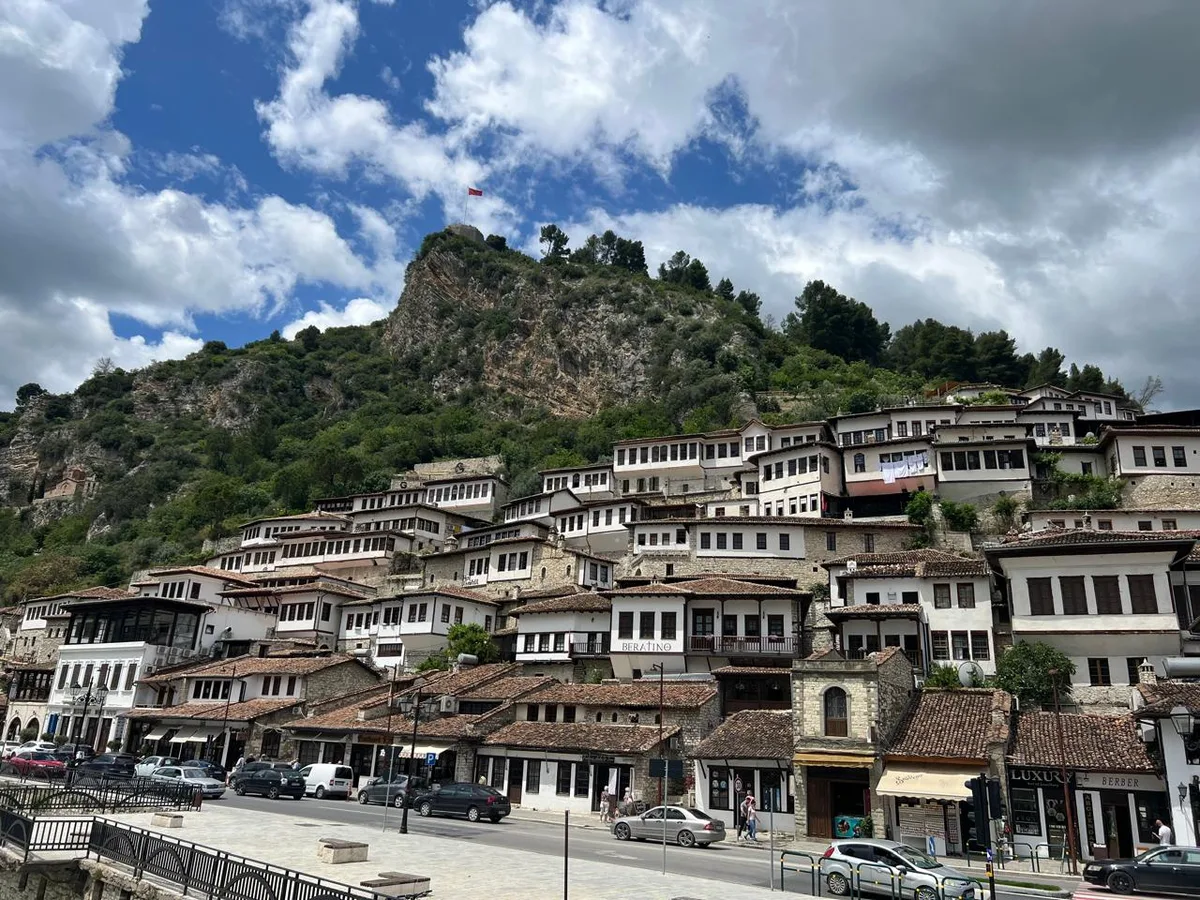
Berat, the "City of a Thousand Windows", and Gjirokastër, the "City of Stone", are both UNESCO World Heritage towns. In Berat, the white Ottoman houses climb the hill like stacked boxes; inside the castle walls people still live, hang laundry and sell homemade jam. Look for the Onufri Museum and its icons painted with a red that artists still cannot fully reproduce. Locals say the Tomorr mountain that watches over Berat is the home of the gods – every August, Bektashi pilgrims climb it to honour Abbas Ali.
Gjirokastër is the hometown of the writer Ismail Kadare and the place where stone roofs shine silver after rain. The castle entrance is around 400 lek (about €4). In his novel Chronicle in Stone, Kadare describes a city so steep that a person who slipped in the street could land on someone's roof – walk the lanes and you will understand.
Then comes the coast. The Albanian Riviera from Vlora to Saranda is where Albanians spend their own summers, and we have opinions about every bay. Drive over the Llogara Pass, where the mountains drop straight into the Ionian Sea. Swim at Dhërmi, Jale and Gjipe, then continue to Butrint, an ancient city inhabited for over two thousand years. Legend says it was founded by Trojan refugees after the fall of Troy, following the poet Virgil. Adult entry is around 1,000 lek, and children under 12 enter free. On the way, stop at the Blue Eye spring, where cold water bubbles up from more than 50 metres below; the entrance is a symbolic 50 lek per person.
Many visitors skip the east, and that is a mistake. Korça is a city of serenades, cobbled streets and the first Albanian-language school, opened in 1887. People here are proud, a bit romantic, and very serious about their food – try lakror, a thin layered pie, and the local beer, brewed since 1928. Twenty-five minutes away, Pogradec sits on Lake Ohrid, one of the oldest lakes in Europe. The lake is home to the koran, an endemic trout that locals speak about almost with reverence; it is now protected, so ask restaurants where their fish really comes from.
Whatever region you visit, food will be at the heart of it. In the north, try flija, made of layers of batter cooked slowly under a metal lid covered with embers. In central Albania, tavë kosi – lamb baked with yoghurt and eggs – is our Sunday dish. In the south, the coast gives you grilled fish and olive oil, and the mountains of Përmet give you gliko, fruit preserves served to guests with a glass of cold water. A full meal in a family-run restaurant outside the tourist hotspots still often costs €10–15.
Accept invitations when they come. If a stranger offers you coffee or raki, it is not a sales trick – it is usually just how we are. A small gift, like sweets for the children, is the perfect way to say thank you.
The best way to understand our country is to hear its stories where they happened – on the castle walls of Rozafa, in the bazaar of Kruja, under the windows of Berat. That is why we created our free audio tours: so every visitor can feel like they are walking beside a local friend.
Start exploring our audio tours of Albania, and discover more legends, guides and travel ideas on our blog. Do you have a question about your trip, a place you are curious about, or a story you heard and want to understand? Write to the author – we read every message, and we answer like we would answer a guest at our own table. Mirë se vini në Shqipëri – welcome to Albania.
Written by A Hila
How it works
Plan Your Visit to Albania
Choose how you want to explore
Listen to this destination's audio tour free — or book a private guided experience.
Open Audio Tour Book a Guided Tour