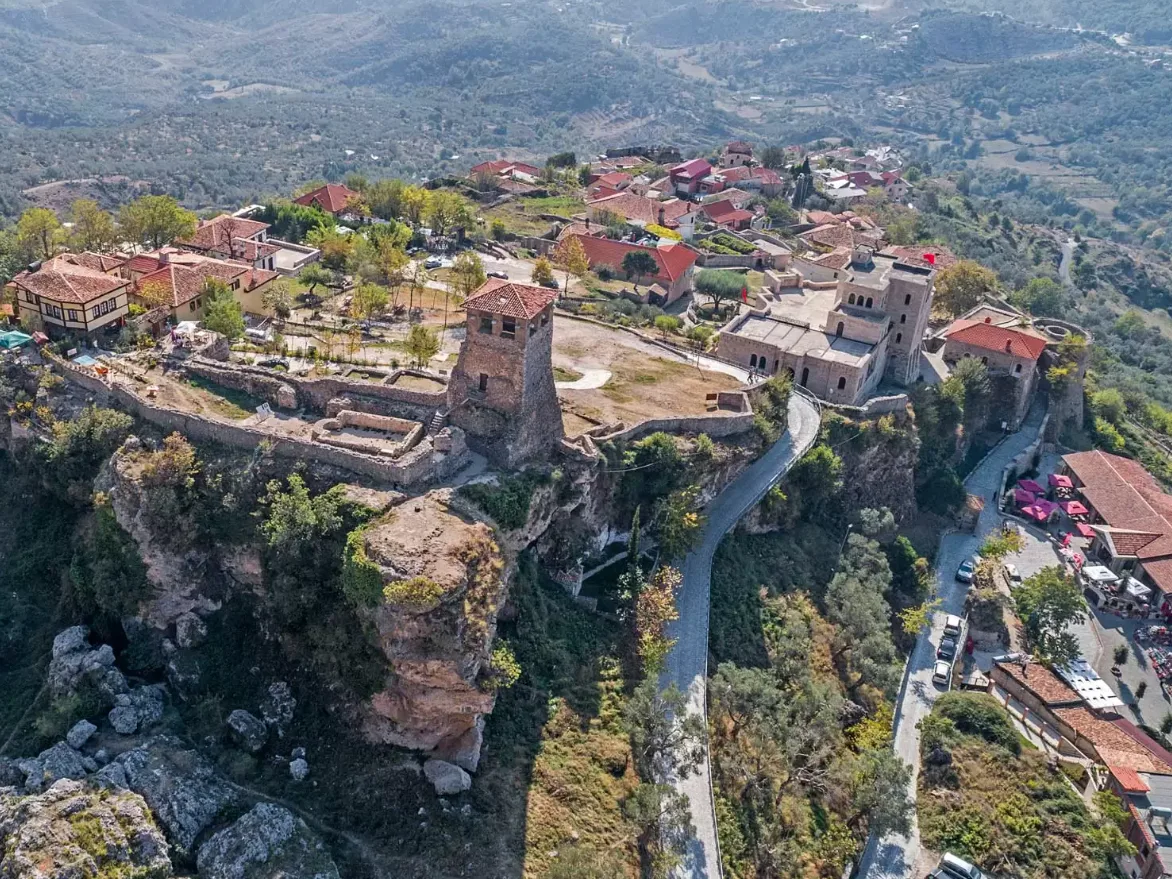
Krujë travel guide: Skanderbeg Museum (500 Lek), the 1450 siege that defeated 100,000 Ottomans, the old bazaar and how to day-trip from Tirana in 4–6 hours.
Perched at 600 metres on the western slope of Mount Krujë, the small town of Krujë (population 8,921) is where Albania's national hero Skanderbeg defied the Ottoman Empire for 25 years. On 28 November 1443 he tricked the local subaşi with a forged letter from Sultan Murad II and raised the first modern Albanian flag over the castle. Krujë sits 31 kilometres north-east of Tirana, a 40–50 minute drive, and is the country's classic half-day excursion — castle, museum, Ottoman bazaar, mountain views.
The fortress on the rock above the town was already old when Skanderbeg arrived: a 5th–6th century Byzantine foundation, capital of the Principality of Arbanon under Progon in 1190. What made it world-famous was Gjergj Kastrioti — Skanderbeg — who defected from Ottoman service in 1443. In the most celebrated of his three sieges, in 1450, between 1,500 and 2,000 Albanian defenders under Skanderbeg and his lieutenant Vrana Konti held off an Ottoman force of around 100,000 led by Sultan Murad II in person. The sultan died on the way back to Edirne the following year. After Skanderbeg's death in 1468, the castle finally fell to Mehmed II in 1478.
Krujë's history did not stop with the Ottomans. On 20 September 1906 the Tallajbe ambush, in which the local pasha Şemsi Pasha was killed alongside roughly 30 rebels and civilians, was an early flashpoint of the Albanian National Awakening that led to independence in 1912.
Park at the lower entrance and walk up the cobbled lane lined with souvenir stalls into the castle grounds (free, accessible 24/7). Inside the walls, the unmissable site is the Skanderbeg Museum, designed by Pranvera Hoxha (yes, the dictator's daughter and the architect of Tirana's Pyramid) and opened in 1982. Entry is 500 Lek (about €5), open 09:00–18:00 with extended summer hours to 19:00. Allow 45–90 minutes for the chronological galleries of replica armour, banners and battle dioramas. Adjacent, in a restored 19th-century house, the Ethnographic Museum shows northern Albanian rural life — looms, kilns, kitchens — and is considered one of the best of its kind in the country.
From the museum, follow the path to the Watchtower viewpoint for the panoramic Tirana-plain view that explains why a fortress was built here. The Dollma Tekke, a small Bektashi shrine inside the castle, is open most daylight hours and free; for a more strenuous visit, hike up to the Sari Saltik shrine on the mountain above the town (1.5–2 hours each way).
Back in the town, the Old Bazaar is a single cobbled street of restored Ottoman shops selling carpets, copperware, antique pistols, lace and rakia — prices are lower than in Tirana for the same items, but bargain politely. Restorant Bardhi at the bazaar's lower end serves the local mountain cooking that Krujë is known for.
Krujë's table is mountain Albanian: byrek with cheese, spinach or meat; kabuni (a sweet rice dish with lamb, cinnamon and raisins served at celebrations); tavë kosi (lamb under yogurt); fërgesë; and grilled meats from the local stockmen. Most bazaar restaurants serve a full meal with house wine for €10–15. The local rakia, often distilled from mulberries grown on the lower slopes, is sold in bazaar shops in characteristic glass bottles for €5–10.
From Tirana, Krujë is 31 km / 40–50 minutes by car or bus. Buses leave from the North & South Bus Terminal for 100–150 Lek and run roughly hourly until late afternoon. A taxi from Tirana costs around €25–30 one way. The town itself is small and steep — comfortable shoes are essential. Allow four to six hours total, including travel — perfect as a half-day from Tirana.
| Town population | 8,921 (2023) |
|---|---|
| Elevation | 600 m |
| Distance from Tirana | 31 km / 40–50 min |
| Skanderbeg Museum | 500 Lek; 09:00–18:00 (19:00 summer) |
| Castle grounds | Free, 24/7 |
| Best time | Spring (Apr–Jun), autumn (Sep–Oct) |
| Recommended stay | Half day (4–6 hours) |
Krujë is most often paired with Durrës (37 km away) for a full Tirana day trip — castle in the morning, Roman amphitheatre and beach lunch in the afternoon. For travellers heading north, Krujë sits on the road to Lezhë (Skanderbeg's burial place) and Shkodër. Albanian Eagle Tours' 3-day Albanian Castles & Riviera private tour begins with Krujë and connects it directly to the Skanderbeg story across the country, while the 6-day Classic Albania tour includes Krujë on day 1. If you want only a guided day, ask about a private Tirana–Krujë–Durrës day trip — it is one of the most-booked single-day itineraries in the country.
Yes, for anyone interested in Skanderbeg, Albanian identity or Ottoman bazaars. The combination of castle, museum, bazaar and mountain views in one walkable cluster is unique in Albania.
Easily — most travellers spend 4–6 hours including travel. Combine with Durrës in the same day if you want a longer outing.
45–90 minutes is typical. The exhibits are mostly Albanian-labelled but the layout is chronological and visually rich; English-speaking guides are available at the entrance.
Yes, but politely — start at around 70% of the asking price for souvenirs. Carpet and copperware shops will negotiate; food and rakia are typically fixed-price.
The cobbled bazaar lane has roughly 50 small shops, several family-run for three or four generations. The most distinctive Krujë crafts include kilim rugs with the classic two-headed eagle motif (€80–250 for a wall-sized hand-loomed piece), antique Ottoman pistols and yatağans (verify export legality on anything genuinely old), copper coffee sets (€20–50), heavy wool qeleshe hats (€10–20), and silver filigree jewellery from Shkodra workshops. Bargaining is expected on rugs, copper and weapons — start at 70% of the asking price. Foodstuffs (rakia, mountain honey, dried herbs) are typically fixed-price.
For travellers who want more than the half-day castle visit, the climb to the Sari Saltik shrine on Mount Krujë above the town is the local hidden walk. The trail starts behind the castle and climbs through limestone ridges to a small Bektashi Muslim shrine inside a natural cave at around 1,300 metres. Allow 1.5–2 hours up, 1 hour down. The shrine is open and free; the panoramic view stretches from the Adriatic to the Tirana basin. Wear sturdy shoes and carry water — there is no facility en route.
The classic full-day from Tirana sequences Krujë in the morning (castle, Skanderbeg Museum, bazaar, lunch in a bazaar restaurant) with Durrës in the afternoon (Roman amphitheatre, Venetian tower, optional beach) — total driving 2.5 hours, total active time 6 hours. By private car or guided tour this is comfortable; by public transport it requires changing buses in Tirana and is slow.
The Skanderbeg Museum's chronological galleries — armour, banners, the 1450 siege diorama — are visually striking but mostly Albanian-labelled. A private guide explains why Skanderbeg's resistance mattered to Renaissance Europe (he was a household name from Rome to London and the subject of a Vivaldi opera in 1718), and why his death in 1468 set the political conditions that locked the western Balkans inside the Ottoman Empire for the next four centuries. Albanian Eagle Tours combines Krujë with Tirana and Durrës in a single English-language private day, and connects the Krujë chapter to the wider Skanderbeg story at Lezhë and Berat in multi-day itineraries.
Once the Ottomans took the castle in 1478, Krujë slipped out of geopolitical headlines for nearly four centuries. Under Ottoman rule it became a regional market town for the surrounding villages, with the bazaar developing along its present cobbled lane in the 17th–18th centuries. The 19th-century National Awakening pulled Krujë briefly back into the political foreground — the 1906 Tallajbe ambush, in which Şemsi Pasha was killed, was an early sign of provincial unrest. The town's population remained small (under 5,000 for most of the 20th century), and the post-1990 transition brought significant emigration to Tirana and abroad. The 2023 census records 8,921 town inhabitants and 51,191 across the wider municipality. Today most of the town's working economy is built around tourism, the bazaar, and small-scale agriculture on the lower slopes — particularly olive cultivation and mulberry-rakia distillation.
Make Krujë part of your trip. Choose the 3-day Albanian Castles tour or the 6-day Classic Albania tour with Albanian Eagle Tours.
🗺 North Albania — Explore Nearby
Each destination is reachable by private Car & Driver from Tirana. View all organised tours →
Plan your visit to Krujë
How it works
Plan Your Visit to Albania
Choose how you want to explore
Listen to this destination's audio tour free — or book a private guided experience.
Open Audio Tour Book a Guided Tour