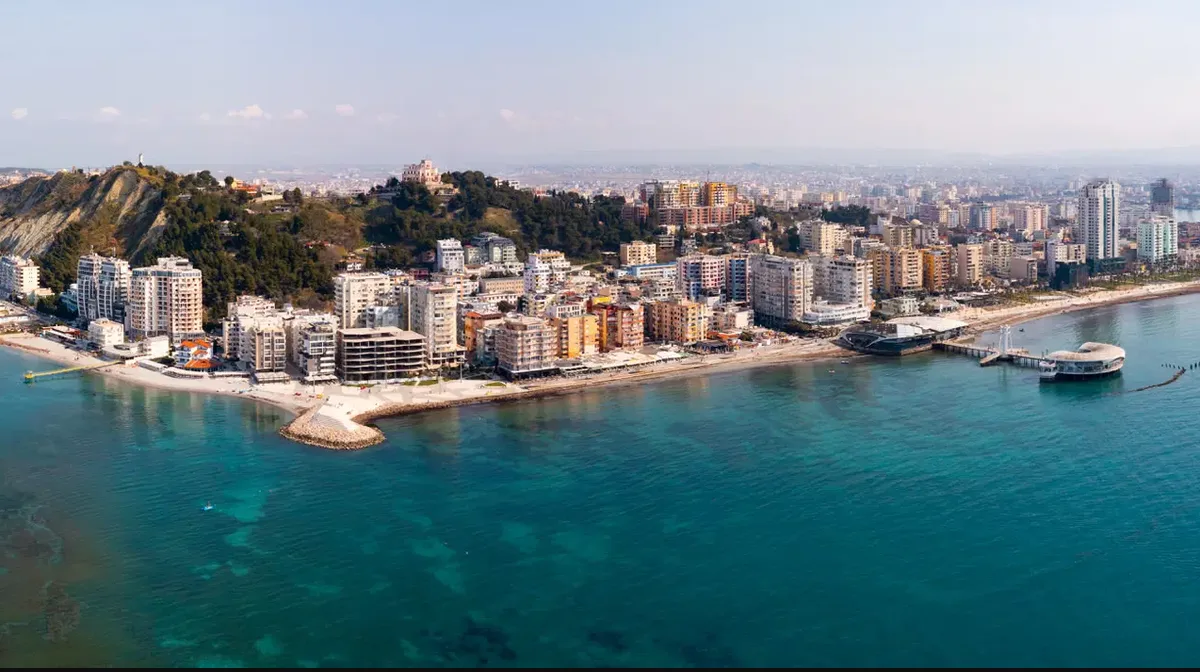
Durrës travel guide: Balkan's largest Roman amphitheatre (300 ALL), Venetian Tower, King Zog's villa, Golem beaches and where Albania's flag rose in 1912.
Founded in 627 BC as the Greek colony of Epidamnos and renamed Dyrrachium under Rome, Durrës is one of the oldest continuously inhabited cities on the Adriatic. It is also where Ismail Qemali raised the Albanian flag on 26 November 1912 — three days before he formally declared independence in Vlora. Today Durrës is Albania's second-largest city (101,728 in 2023) and its main commercial port, a 38-kilometre, 20-to-40-minute drive from Tirana that combines a Roman amphitheatre, Venetian fortifications and a 15-kilometre sandy beach.
Epidamnos was founded by Greek colonists from Corinth and Corfu, who quickly fell out over its lucrative Adriatic trade. The dispute was a contributing cause of the Peloponnesian War as recorded by Thucydides. Under Rome, the city sat at the western end of the Via Egnatia, the imperial road that ran east to Byzantium. The most famous moment in its Roman life came in 48 BC, when Julius Caesar besieged Pompey here — Caesar was defeated at the Battle of Dyrrachium, only to win the campaign three months later at Pharsalus.
The walls you can still walk along owe their final form to the Byzantine emperor Anastasius I, who was born in Dyrrachium and rebuilt them between 491 and 518 CE after a devastating fourth-century earthquake. Venetian rule (1392–1501) added the squat round tower that still anchors the port quarter; Ottoman rule from 1501 layered mosques and bazaars over the medieval core. Briefly, in February–March 1914, Durrës was the capital of Prince Wied's short-lived Principality of Albania.
The single must-see is the Durrës Amphitheatre, the largest Roman amphitheatre in the Balkans — built in the early 2nd century AD under Trajan with capacity for an estimated 15,000–20,000 spectators. Open daily 09:00–18:00, entry 300 ALL (about €3). A small early-Christian chapel inside the arena preserves a 6th-century mosaic of saints, an unusual layering of pagan and Christian use on the same site. Allow an hour.
From the amphitheatre, walk five minutes to the Venetian Tower (free, open 24/7) — climb for the best view over the harbour. The Durrës Archaeological Museum on the seafront houses one of Albania's most important Illyrian and Roman collections, including the famous "Beauty of Durrës" mosaic and stelae from the necropolis. Continue ten minutes inland to the surviving stretch of Anastasian walls and the Great Mosque of Durrës, rebuilt in 1931 on Ottoman foundations. Above the city, on a hill that catches the sea breeze, sits the Royal Villa of King Zog, built in the 1930s and now mostly closed but a striking exterior viewpoint.
For beaches, head 8–15 km south to Golem and Mali i Robit, where the sand is fine and the water shallow — ideal for families. The northern stretch towards Currila is rockier and quieter.
Durrës eats from its sea. Order grilled sea bass (levrek në zgarë) or fried calamari at any seafront restaurant; tavë e dheut is the local clay-pot baked dish, often with veal and onions. Japrak (stuffed grape leaves) and house-made qofte are the standard meze. The two indigenous grape varieties — Shesh i Zi (red) and Shesh i Bardhë (white) — take their name from the Shesh village just inland. Both pair beautifully with grilled fish and are usually under €15 per bottle in restaurants.
May and September are ideal: the sea is warm enough to swim, daytime highs are 22–28 °C and the beach hotels are not yet packed with domestic holidaymakers. July and August are hot, busy and noisy. November–March is mild but quiet, with most beach restaurants closed. One full day is enough for the historical core; two if you want a beach afternoon.
| Population | 101,728 (2023) |
|---|---|
| Elevation | ~10 m |
| UNESCO status | Amphitheatre on Albania's Tentative List |
| Founded | 627 BC as Epidamnos |
| Distance from Tirana | 38 km / 20–40 min |
| Amphitheatre entry | 300 ALL, daily 09:00–18:00 |
| Recommended stay | 1–2 days |
Durrës pairs naturally with Krujë (44 km north-east) — Skanderbeg's hilltop fortress and bazaar — for a full day-trip loop from Tirana. South of Durrës, the coastal motorway runs to Apollonia, Vlora and the Riviera. Albanian Eagle Tours' 3-day Albanian Castles & Riviera private tour includes Durrës as part of a fortress-by-fortress route to the Ionian coast, while the 6-day Classic Albania private tour stops in Durrës en route between Tirana and Apollonia. Travellers focused on Roman and Greek archaeology will get more out of the Tirana–Apollonia–Vlora 3-day city break, which combines Durrës-style coastal Roman heritage with the much larger ruins at Apollonia.
Yes. The amphitheatre and Venetian Tower take half a day; combine with lunch on the seafront and an afternoon at Golem beach for a full day. With a private car or guide you can be back in Tirana for dinner.
It is the largest Roman amphitheatre in the Balkans, with an estimated original capacity of 15,000–20,000. It was discovered by accident during construction work in 1966.
The beaches at Golem and Mali i Robit (8–15 km south) have fine sand and shallow water. The city beach itself is busier and the sand coarser. Sea quality is best outside July–August.
Yes, it is a 10-minute walk inland from the ferry terminal. Most cruise passengers do exactly this self-guided loop covering the amphitheatre, Venetian Tower and seafront.
Start at the Durrës ferry terminal, walk five minutes inland to the Forum/Macellum (Roman market, free, partly excavated), then continue to the Amphitheatre entrance on Rruga Kalasë for the 300 ALL ticket. After 60–90 minutes among the arena and the early-Christian chapel mosaics, walk to the Venetian Tower (free, climb the spiral stairs for the harbour view). From the tower, follow Rruga Anastas Durrsaku to the Archaeological Museum on the seafront — its Beauty of Durrës mosaic and the Illyrian collection take another hour. Finish with grilled fish at Restaurant Te Pisha or Rumba on the seafront promenade.
Drive 25 minutes north of Durrës to Cape Rodon, where Skanderbeg built a small fortress in 1463 — the Adriatic-facing tip and adjacent Church of Saint Anthony of Padua are a wild and quiet alternative to the busy city beach. Inland, the Royal Villa of King Zog on Durrës hill (1930s, exterior only) offers panoramic views. The Basilica of Arapaj, 8 km south of the city, is a substantial 6th-century Christian basilica with surviving floor mosaics — free, daylight hours, often empty.
The 15-kilometre Durrës–Golem beach strip is Albania's most developed stretch of Adriatic coast. Currila (3 km north of the city) is rocky and quieter; the central city beach is busy and partly built up; Golem (8–12 km south) has fine sand and shallow water — ideal for families with young children. Mali i Robit (15 km south) has the cleanest water along this coast. Beach-club entry is typically free; chair-and-umbrella rental runs €8–15 per pair per day. Beach restaurants serve grilled sea bass and Shesh i Bardhë house wine for €15–25 per person.
The two-hour amphitheatre-and-Venetian-tower walk is easy to do solo, but the wider Durrës story — Caesar's defeat by Pompey at the Battle of Dyrrachium in 48 BC, Anastasius's massive walls, the 1912 flag-raising by Ismail Qemali three days before the Vlora declaration — is much richer with a guide who can place you on the exact streets where each event happened. Albanian Eagle Tours combines Durrës with neighbouring sites (Krujë, Cape Rodon, Apollonia) in a single private day, removing the bus-station gymnastics that public transport requires.
Durrës has been struck by major earthquakes throughout its history — the 4th-century event that prompted Anastasius's wall rebuild, a 1267 earthquake that damaged the cathedral, and most recently the magnitude 6.4 earthquake of 26 November 2019, which killed 51 people across the country and damaged several historic buildings in Durrës including parts of the city walls. Restoration work continued through 2023 and most central monuments are now stable and visitable. The amphitheatre's Roman fabric was largely unharmed, but visitors should expect occasional scaffolding around medieval and Ottoman structures still under repair. The post-earthquake reconstruction has also accelerated improvements to the seafront promenade and the central Sheshi i Lirisë square, which now ranks among the most pedestrian-friendly central spaces on the Albanian coast.
See Durrës with a private guide. Book the 3-day Albanian Castles & Riviera tour or the 6-day Classic Albania tour with Albanian Eagle Tours.
🗺 Central Albania — Explore Nearby
Each destination is reachable by private Car & Driver from Tirana. View all organised tours →
Plan your visit to Durrës
How it works
Plan Your Visit to Albania
Choose how you want to explore
Listen to this destination's audio tour free — or book a private guided experience.
Open Audio Tour Book a Guided Tour