Ten lesser-known places in Albania from a local's road-trip notebook: Kelmend, Drisht, Rodon, Lin, Maligrad, Voskopojë, Nivica, Antigonea and more.
Quick answer: Some of the best lesser-known places to visit in Albania are the Kelmend valleys of Lëpushë and Vermosh in the far north, Drisht Castle near Shkodër, the Cape of Rodon on the Adriatic, the 6th-century mosaics of Lin on Lake Ohrid, the island cave church of Maligrad on Lake Prespa, the old trading town of Voskopojë, the canyons of Nivica, and the ancient cities of Antigonea and Phoenice in the south. Most are within two to three hours of a major town, and in 2026 they still see only a small share of Albania's visitors.
I keep an old notebook in the glove box of my car (call it my small, moderate statement to myself to resist the digital world). Every time I drive somewhere in Albania that makes me pull over and stay longer than planned, I write a few lines in it. Over the years, many of those pages have filled with places that never appear on the first page of a travel search. So this article is a road trip through that notebook, from the mountains on the Montenegrin border down to the hills above the Ionian Sea. Pour yourself a coffee; it is a long drive, but a beautiful one.
If this is your first trip, start with the famous names in our guide to the best places to visit in Albania. The places below are for the second trip, or for the traveler who wants to see what lies just beyond the well-known stops.
From Shkodër, the road climbs north through Koplik and Rrapsh, then twists down the famous hairpins of Leqet e Hotit to Tamarë. Keep going through Selcë and you reach Lëpushë and Vermosh, high valleys of meadows, haystacks and wooden houses near the border with Montenegro. The road is paved, and family guesthouses serve cheese, honey and mountain tea on the porch. This is the land of the xhubleta, the bell-shaped woolen dress of the highland women, inscribed by UNESCO in 2022 on its List of Intangible Cultural Heritage in Need of Urgent Safeguarding. Ask your hosts whether any older women in the village still have one at home; it is a moving thing to see.
These valleys are also the setting of the northern epic songs. One of the most loved is the legend of Gjergj Elez Alia, a hero who lay wounded for nine years, cared for by his sister, until a monster from the sea, the Bajloz, came demanding tribute. Gjergj rose from his bed, defeated the Bajloz, and then he and his sister died in each other's arms. Highlanders still sing it with the lahuta, the one-stringed fiddle. Walk the trail between Vermosh and Lëpushë from June to October, and you will understand why heroes in these songs are made of stone and wind.
Just a short drive east of Shkodër, a narrow road climbs to the village of Drisht and the ruins of a castle about 300 meters above the plain. Its oldest walls are dated to around the 10th century, with later layers from the 13th and 14th centuries, and in the Middle Ages Drisht was a bishop's seat. Today, a few families live inside and around the old walls, and you may be offered coffee on a terrace with a view across the Kir River valley toward Shkodër. Combine it with a visit to Rozafa Castle; my Shkodër guide tells you how.
An hour from Tirana, north of Durrës, a long green finger of land points into the Adriatic. At its tip stand the ruins of a castle traditionally attributed to Skanderbeg, our national hero, and the small Church of Saint Anthony, declared a cultural monument in 1963. Much of the castle has slipped into the sea, which makes the ruins even more romantic. Bring a picnic, walk out along the cliffs in the late afternoon, and stay for a sunset that Albanians from Durrës will tell you is the best on the coast.
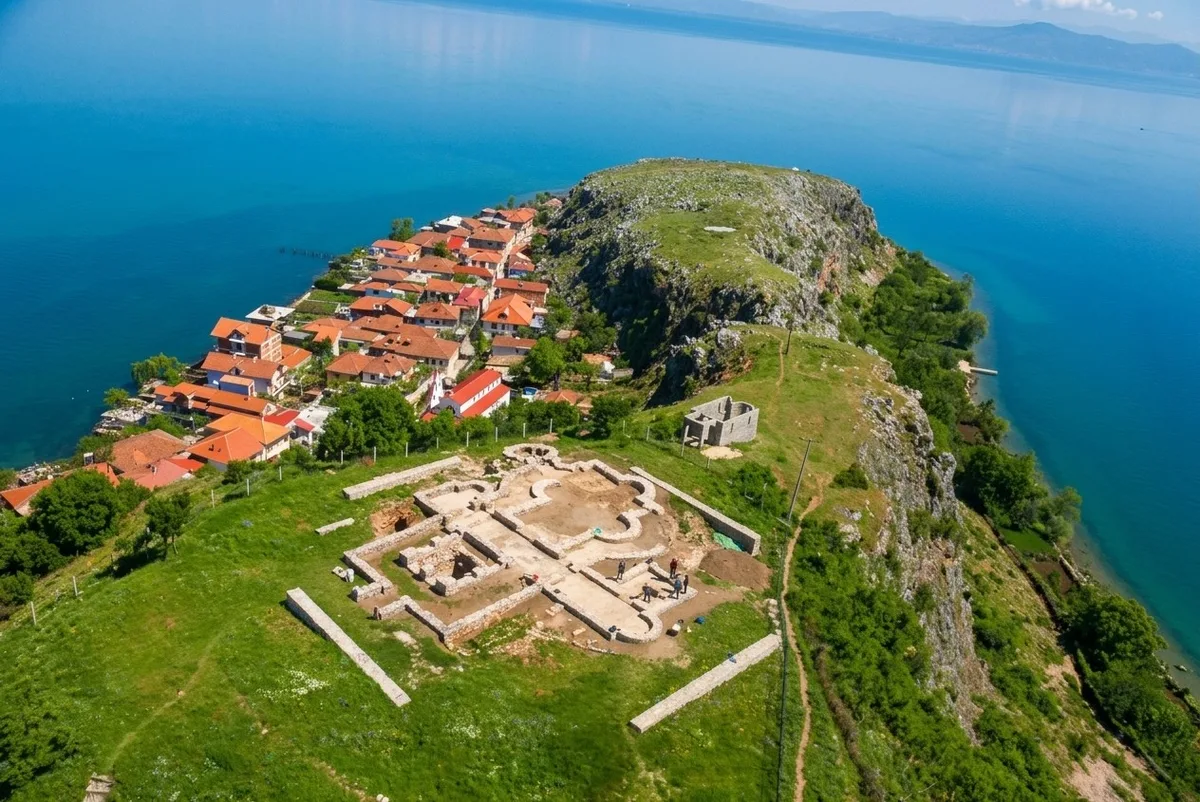
Lin is a fishing village on a small peninsula on the Albanian shore of Lake Ohrid, about half an hour north of Pogradec. On the hill above the houses lies an early Christian basilica from the 6th century, with mosaic floors showing bees, birds pecking grapes and geometric patterns in red, green, white and orange. Below the hill, archaeologists have found traces of a prehistoric pile-dwelling settlement. Eat fresh fish at a family restaurant by the water and swim from the rocks, and you will wonder why so few people come. Note that the Elbasan–Përrenjas road toward the lake is under construction in 2026 and expected to be ready by around 2028, so allow extra time. For more, see my Pogradec guide.
East of Korçë, Lake Prespa is shared by Albania, North Macedonia and Greece. On the Albanian side, the village of Zaroshkë looks out at the tiny island of Maligrad, where the Church of Saint Mary hides inside a natural cave in the cliff. It was built in 1369 by the nobleman Kesar Novak, who appears in its frescoes. Local fishermen take visitors across in small boats in summer. The silence of Prespa, with pelicans gliding over the reeds, is something I always try to describe to friends and never manage.
Voskopojë, in the mountains about 20 kilometers west of Korçë, is now a quiet village of stone houses and beech forests. In the 18th century, it was one of the great trading towns of the Balkans, with a school known as the New Academy from 1744 and its own printing press. Raids in 1769 and 1788 destroyed much of the town, but several frescoed churches survive, including Saint Nicholas, painted by David Selenica and his workshop. Come in October, when the forest turns gold, or in winter for snow and a fire in a guesthouse.
The south is where legends and myths passed through generations meet Illyrian hill forts, cities built by the kings of Epirus, and churches raised by Byzantine builders. Here are four places where you can feel all those layers at once.
In the Kurvelesh highlands, about 20 kilometers from Tepelenë, the Nivica canyons cut deep into the limestone. Marked trails from Nivica village lead to viewpoints, a waterfall and natural pools. Kurvelesh is the heart of Labëria, and if you are lucky, you will hear the Lab iso-polyphonic singing, where one voice holds a drone while others weave around it. This tradition is inscribed by UNESCO as Albanian folk iso-polyphony.
East of Gjirokastër, on the road toward Libohovë, the village of Labova e Kryqit has one of the oldest churches in Albania, dedicated to Saint Mary. Tradition says it once held a fragment of the True Cross, which is how the village earned its name, "Labova of the Cross". Whatever you believe, the stone church in its quiet village feels much older than the busy road below. Pair it with the stone city itself; my Gjirokastër guide has the full story.
On a ridge above the Drino Valley near Gjirokastër lies Antigonea, founded in 295 BC by King Pyrrhus of Epirus and named after his first wife, Antigone. Yes, the same Pyrrhus who gave us the phrase "a Pyrrhic victory", a battle won at such a cost that it feels like defeat. The city was destroyed by the Romans in 167 BC, and today it is an archaeological park of walls, foundations and wildflowers, usually with almost nobody else around.
Near Sarandë, on a steep hill above the town of Finiq, lie the ruins of Phoenice, the capital of the Chaonians, one of the peoples of ancient Epirus. The view from the top reaches across the plain to Butrint and Corfu. A short drive away, the Monastery of Saint Nicholas at Mesopotam, from the 13th century, stands in a green valley, with carved stone decorations on its walls. Most visitors drive past both on the way to the beach; I suggest you stop.
The Kelmend valleys of Lëpushë and Vermosh, the mosaics of Lin on Lake Ohrid, the cave church of Maligrad on Lake Prespa, Voskopojë near Korçë, and the ancient city of Antigonea near Gjirokastër are among the most underrated places in Albania.
Most are reachable by paved road within two to three hours of Shkodër, Korçë, Gjirokastër or Sarandë, but public transport is limited, so a rental car or a local driver is the easiest option.
June to October is best for the northern mountains and Lake Prespa, while the south and Lake Ohrid are pleasant from spring to autumn. Voskopojë is also beautiful in October and in winter.
Yes. Crime against tourists is rare, and villagers are usually very hospitable. The main precautions are driving carefully on mountain roads and carrying enough cash, water and fuel.
The best hidden place in Albania may be one I have not found yet, and maybe you will tell me about it. Before you set off, listen to our Albania audio tours, which bring castles, old towns and ancient sites to life with the legends Albanians grew up with. You can find out more ideas and practical guides on our blog. And if you want a route that fits your days, your car or your curiosity, ask me anything. Planning someone's trip is one of my favorite ways to spend a coffee break.
Written by A Hila
How it works
Plan Your Visit to Albania
Choose how you want to explore
Listen to this destination's audio tour free — or book a private guided experience.
Open Audio Tour Book a Guided Tour