Gjirokastër travel guide: UNESCO old town, fortress (400 ALL), Skenduli & Zekate houses, 1880 League congress, Blue Eye spring 36 km, Enver Hoxha's birthplace.
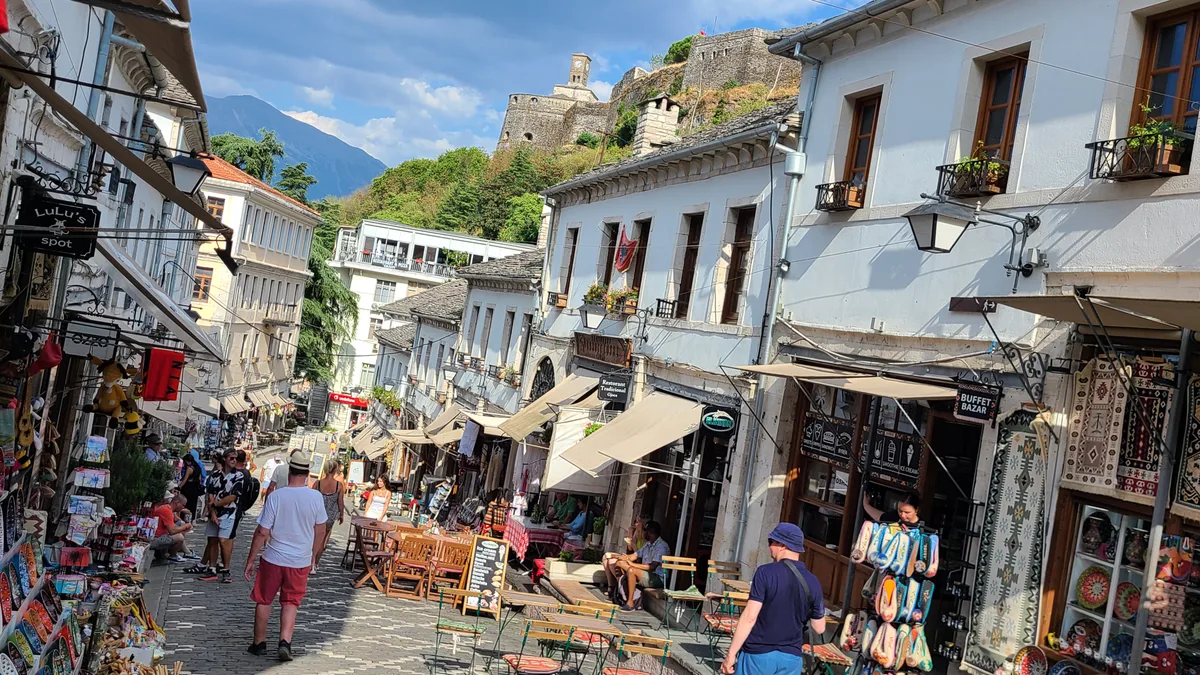
Gjirokastër (population 19,836) climbs the slopes of the Drino Valley in stacked layers of grey stone — silver-roofed houses that turn the whole town into a single quarry of dressed limestone. UNESCO inscribed it in 2005 as part of "the Historic Centres of Berat and Gjirokastër". Above the houses sits one of the largest castles in the Balkans; below, the Drino Valley runs south to the Greek border 36 km away. From Tirana it is 223 km / 3 hours.
Gjirokastër is first mentioned in 1336 by the Byzantine emperor John VI Kantakouzenos as Argyrókastron, the "silver fortress". The Albanian Zenebishi family controlled it from the late 14th century — Gjon Zenebishi defeated Esau de' Buondelmonti here in 1399 — and the town surrendered to the Ottomans in 1418 after a siege. Skanderbeg's revolt brought a second siege in 1432–1436, led by Depë Zenebishi.
The town's modern political weight is heavy. On 23 July 1880 Gjirokastër hosted a major congress of the League of Prizren, the National Awakening movement that fought to keep Ottoman Albania from being partitioned. The first Albanian-language school in Gjirokastër opened in 1908. From 1914 the town was the capital of the short-lived Autonomous Republic of Northern Epirus under Georgios Christakis-Zografos — a Greek-aligned breakaway state that lasted under a year.
And on 16 October 1908, Enver Hoxha, the dictator who would rule Albania from 1944 to 1985, was born in a Gjirokastër stone house — today the Ethnographic Museum.
Gjirokastër Fortress dominates the town from a 300-metre ridge. Open daily 09:00–19:00 in summer, 09:00–17:00 in winter; entry 400 ALL (about €4) for adults, 300 ALL for groups, 200 ALL for seniors. Inside the walls: a vaulted gallery of captured Italian and German artillery, a 1957-installed two-seater US Air Force T-33 jet whose pilot was forced down in 1957 (its presence intensifying Hoxha's paranoia about Western infiltration), and the National Folk Festival amphitheatre that hosts the famous quintennial gathering.
Below the fortress, the Old Bazaar spreads outward in cobbled lanes lined with 18th- and 19th-century shops. The Skenduli House and Zekate House, both restored Ottoman tower-houses with original carved wooden ceilings, painted niches and women's apartments, are the two best examples of Gjirokastër stone-house architecture (each around 200 ALL, daylight hours). The Ethnographic Museum in Hoxha's birth-house presents traditional Gjirokastër life — the building itself is the main exhibit. The Gjirokastër Mosque (1757) anchors the bazaar.
For an extra hour, hike the Ali Pasha Bridge aqueduct ruins above the town (30-minute walk, free).
Gjirokastër has its own cooking tradition. Look for oshaf, a lamb-and-fig dessert eaten on Bayram, and qifqi — small fried rice-and-mint-and-egg balls that are the town's snack food. Tavernas Kardhashi and Te Kuqa in the Old Bazaar are reliable for traditional menus. The Barrels vineyard restaurant on the edge of town serves Gjirokastër's own dry whites and rich reds — a useful lunch if you have a car.
March–May and September–November are best — 18–26 °C, fewer cruise-ship coaches up from Saranda. July–August are hot and busy. From Tirana, allow 3 hours by car; intercity buses cost around 1,200 Lek and take 4–4.5 hours. Plan 1–2 days for the town, 3 if combining with the Blue Eye and Saranda.
| City population | 19,836 (2011 census); 16,569 (2023 est.) |
|---|---|
| Elevation | 300 m |
| UNESCO | 2005, with Berat |
| Distance from Tirana | 223 km / 3 hr |
| Fortress | 400 ALL adult / 300 group / 200 senior |
| Skenduli & Zekate Houses | ~200 ALL each |
| Recommended stay | 1–2 days (3 with Blue Eye) |
Gjirokastër pairs naturally with Berat — Albania's other UNESCO old town — 2.5 hours north, and with Butrint (UNESCO archaeological site) and the Blue Eye spring (36 km, 35-minute drive south) on a single southern circuit. Albanian Eagle Tours' 3-day Albanian Riviera, Butrint UNESCO and Gjirokastër private tour from Tirana is built around exactly this triangle; the longer 6-day Classic Albania tour includes Gjirokastër as part of a country-wide loop.
The houses, roofs, walls and streets are all built from the same local grey limestone — silver-grey roof slabs replace tiles. Seen from the fortress, the town is a single grey waveform of stone.
Yes. He was born here on 16 October 1908. His birth-house in the Old Bazaar now operates as the Ethnographic Museum — the building's vernacular architecture is the exhibit, not the dictator.
36 km / about 35 minutes by car south on the SH4 toward Saranda. Most day visitors combine the Blue Eye with Butrint and a beach lunch.
Yes, the drive is about 1.5 hours each way. But 1–2 nights in Gjirokastër itself lets you walk the bazaar at dawn and visit the houses without crowds.
The fortress is the largest in Albania and one of the largest in the Balkans, with a footprint that has expanded continuously since the 12th century. Inside the ring walls, the vaulted gallery on the upper level holds the Museum of Armaments — a long row of captured Italian and German Second World War artillery pieces, plus the famous Lockheed T-33 jet whose American pilot was forced down in Albanian airspace in 1957 (the regime kept the aircraft as evidence of "Western infiltration", and it remains here today). The 1957 incident intensified Hoxha's paranoia about US intelligence operations in the country. The fortress also hosts the open-air amphitheatre that holds the Albanian National Folk Festival every five years — the next edition is anticipated in 2028.
The Gjirokastër stone tower-house is a distinct architectural type — a fortified upper storey with hidden rooms, women's apartments separated from men's quarters, and a roof of vast stone slabs. Two are open as private museums:
Both take 30–45 minutes; a combined visit gives a fuller picture than seeing only one.
The Blue Eye spring (Syri i Kaltër) is 36 km / 35 minutes south on the SH4 — a deep karst spring whose central pool is over 50 metres deep and intensely blue. Free (or 50 ALL parking) and best visited early morning before the cruise-ship coaches arrive from Saranda. From the Blue Eye, continue 30 minutes to the coast for lunch in Saranda or a beach afternoon at Ksamil; or loop east to Tepelenë (1 hour) for the Ali Pasha Castle and the Vjosa Valley. Lekuresi Castle above Saranda is the standard sunset stop on the way back.
Gjirokastër's UNESCO inscription is for its urban architecture, and architecture is exactly what a knowledgeable guide unlocks — why each Ottoman house was built the way it was, what political and clan tensions are encoded in the layout, why the fortress was sized so far beyond the population it ever defended. Albanian Eagle Tours' 3-day Albanian Riviera, Butrint UNESCO and Gjirokastër private tour combines Gjirokastër with the southern coast in a logically sequenced private trip.
The Lockheed T-33A on display in Gjirokastër Fortress is one of the most unusual exhibits in any Albanian museum. On 23 December 1957 the aircraft, flown by US Air Force Lieutenant Howard Curran on a training flight from a base in Italy, strayed into Albanian airspace. Soviet-built MiG fighters intercepted it and the pilot landed at Rinas (now Tirana International Airport) without incident. The pilot was eventually returned to the United States, but the aircraft was kept by the Hoxha regime and prominently displayed as evidence of "American aggression". It was relocated to Gjirokastër Fortress in the 1970s. The plane has been restored several times and remains a striking — if somewhat surreal — addition to a medieval fortress originally built to defend against Ottoman armies.
See Gjirokastër with a private guide. Book the 3-day Riviera, Butrint & Gjirokastër tour with Albanian Eagle Tours.
🗺 South Albania — Explore Nearby
Each destination is reachable by private Car & Driver from Tirana. View all organised tours →
Plan your visit to Gjirokastër
🏛 Related Reading
How it works
Plan Your Visit to Albania
Choose how you want to explore
Listen to this destination's audio tour free — or book a private guided experience.
Open Audio Tour Book a Guided Tour