Fier travel guide: founded 1864 by Omer Pasha Vrioni II, gateway to Apollonia (15 km), Ardenica Monastery, Karavasta Lagoon, 115 km from Tirana.
Fier (population 52,926 in the city, 101,963 in the wider municipality) is the largest town in central southern Albania, and the standard launching point for visits to the ancient Greek-Illyrian city of Apollonia 15 km away. Unusually for an Albanian city, Fier was founded in 1864 by Omer Pasha Vrioni II, head of one of the wealthiest Bey families of the late Ottoman period, as a planned market town for the surrounding Myzeqe plain. From Tirana it is 115 km / 1 hour 45 minutes to 2 hours south on the A2 motorway and SH4.
Most Albanian towns evolved organically from medieval or Ottoman cores. Fier is the exception: Omer Pasha Vrioni II, scion of the leading Bey family of the central plain, laid out the town on a regular grid in 1864 to capture the market trade of the Myzeqe agriculture and the Vlora-bound mule routes. The Vrioni family palace and several of their commissioned buildings still anchor the central square. Fier sits on the modern road, but on a more ancient memory: just outside the town, the silt-choked harbour of Apollonia — abandoned around the 4th century AD after a 3rd-century earthquake diverted the Vjosa River — bears witness to what the region once carried.
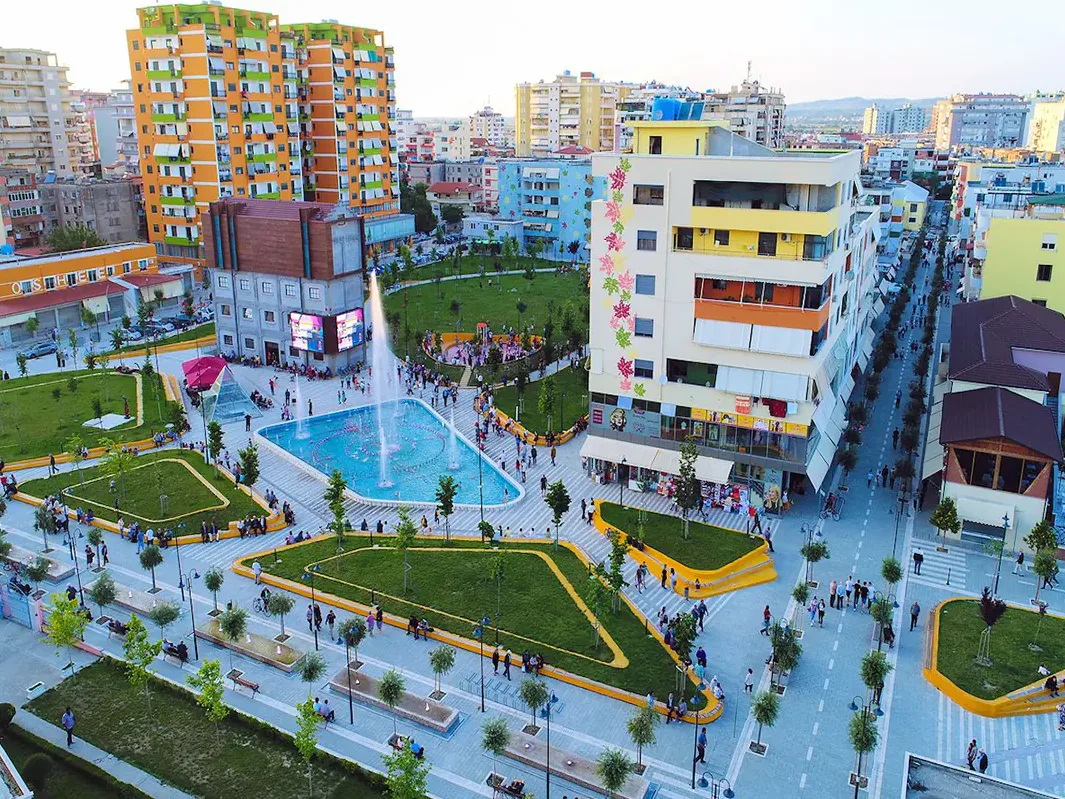
Fier itself has a small but well-curated Historical Museum on the central boulevard (modest entry, Tuesday–Saturday daylight hours) that explains the Vrioni-era founding and the wider Myzeqe agricultural economy. The pedestrian centre is pleasant for an hour's wander, particularly in late afternoon. But the real reason to base in Fier is access:
Fier's restaurants serve the same Myzeqe-plain cooking as the wider region: fërgesë with peppers and white cheese, leek byrek, slow-baked vegetables in clay pots, plus fresh sea bass and shrimps from the nearby lagoons. The local wine is Shesh i Zi (red) and Shesh i Bardhë (white) — the indigenous grapes from Shesh village, just east of the city. House wines are usually €5–8 per litre at restaurants.
Spring (April–June) and autumn (September–October) are ideal — comfortable temperatures for archaeology and birdwatching. July and August are hot in the basin (often 32–36 °C). Most travellers use Fier as a base for half a day to a full day before continuing south to the Riviera; one night in a Fier hotel is enough. Allow 2–3 hours at Apollonia, plus an Ardenica add-on.
| City population | 52,926 (2023) |
|---|---|
| Elevation | 44 m |
| Founded | 1864 by Omer Pasha Vrioni II |
| Distance from Tirana | 115 km / 1 hr 45 min – 2 hr |
| Apollonia entry | 600 ALL (~€6) |
| Distance Fier–Apollonia | 15 km / 25 min |
| Recommended stay | Half to full day |
The classic Fier-based day combines Apollonia in the morning, lunch at a small Karavasta lagoon restaurant, and the Pelican Trail in the afternoon. A longer two-day version adds Ardenica and an overnight in Vlora. Albanian Eagle Tours' Apollonia and Karavasta Lagoon full-day private tour covers the half-day archaeology + lagoon route from Tirana, while the 3-day Tirana–Apollonia–Vlora city break passes through Fier and uses it as a transit stop on the way south.
For its own sake, briefly. As a base for Apollonia and the wider Myzeqe attractions, very much so — most travellers spend 1–2 hours in Fier itself and the rest on day trips.
15 km / 25 minutes by car or taxi (~€10 one way). There is no public bus directly to the site; furgon minibuses go as far as the village of Pojan and you walk the last kilometre.
No — the site is on a separate hill 15 km away. The route is well-signposted from the central roundabout.
Fier itself has reliable mid-range hotels. For more atmosphere, Berat (1 hour east) or Vlora (40 minutes south) are better overnight choices.
The Vrioni family — Albanian Beys with extensive landholdings across the Myzeqe plain — were among the most powerful regional dynasties of the late Ottoman period. Omer Pasha Vrioni II founded Fier in 1864 not as a feudal village but as a planned commercial town: regular grid streets, central market square, mosque, school, customs house. The model was Ottoman administrative urbanism applied to a frontier agricultural economy. The Vrioni palace and several of their commissioned buildings still anchor the centre, though some have been heavily modified. The family lost most of its land in the post-1944 communist nationalisations; the wider Vrioni story is now mostly told in the small Fier Historical Museum.
The 15-km / 25-minute drive from Fier to Apollonia Archaeological Park is the standard route. The road is paved, well-signposted from Fier's central roundabout via the village of Pojan. At the entrance gate, you'll find a small souvenir kiosk and the 600 ALL ticket office. The site itself is large — allow 2–4 hours including the museum in the 13th-century Saint Mary Monastery. There is no food on site; lunch back in Fier or at one of the small village tavernas in Pojan.
From Fier, drive 30 minutes north to Karavasta Lagoon for the Pelican Trail and lagoon-edge fish lunch. South of Fier, 35 km along the SH8, is Vlora and the start of the Albanian Riviera; the Riviera proper begins another 40 minutes south over the Llogara Pass. For travellers who want a single base for both archaeology and beach days, Fier is logistically positioned but not particularly atmospheric — Berat (1 hour east) or Vlora (40 minutes south) make better overnight choices.
The most efficient way to use Fier is as a transit point on a guided day from Tirana — Apollonia in the morning, lagoon and pelican trail in the afternoon, Tirana for dinner. Albanian Eagle Tours' Apollonia and Karavasta Lagoon full-day private tour covers exactly this loop with an English-speaking guide who can read the Apollonia Greek inscriptions and identify the Karavasta birds. For a longer itinerary that uses Fier as a stop on a country-crossing route, the 3-day Tirana–Apollonia–Vlora private city break integrates Fier and Apollonia into a Vlora-bound private trip.
Fier sits in the centre of the most archaeologically dense triangle in Albania. Berat (UNESCO Ottoman city) is 1 hour east; Apollonia (Greek-Roman ruins) is 25 minutes south-west; Vlora (Albania's first capital) is 40 minutes south; Ardenica Monastery (Byzantine) is 30 minutes north; Karavasta Lagoon (Adriatic Ramsar wetland) is 30 minutes north-west. A 2- or 3-day itinerary based in Fier can cover all five with reasonable driving distances. For travellers who prefer to base in a more atmospheric overnight, Berat or Vlora are better — but Fier is the practical day-trip hub for the wider central plain. The town itself has reliable mid-range hotels in the €40–70 range and several good seafood restaurants; the central pedestrian streets are pleasant in the late afternoon when the local xhiro evening promenade fills the boulevard.
If you do choose to overnight in Fier rather than Berat or Vlora, expect simple but functional accommodation in the €40–70 range. The town has a small but reliable cluster of seafood restaurants — fish from the nearby Karavasta and Patok lagoons appears on most menus, alongside the standard Myzeqe vegetable dishes. Furgon minibuses leave Fier's central station for Tirana, Vlora and Berat throughout the day; private taxis to Apollonia run €10 one way. Internet and mobile coverage are good in the centre but variable on the road to Apollonia. ATMs are widely available on the central boulevard. The town is generally calm and visitor-friendly; standard urban precautions are sufficient.
Use Fier as your gateway to ancient Apollonia. Book the Apollonia & Karavasta full-day tour with Albanian Eagle Tours.
🗺 Central Albania — Explore Nearby
Each destination is reachable by private Car & Driver from Tirana. View all organised tours →
Plan your visit to Fier
How it works
Plan Your Visit to Albania
Choose how you want to explore
Listen to this destination's audio tour free — or book a private guided experience.
Open Audio Tour Book a Guided Tour