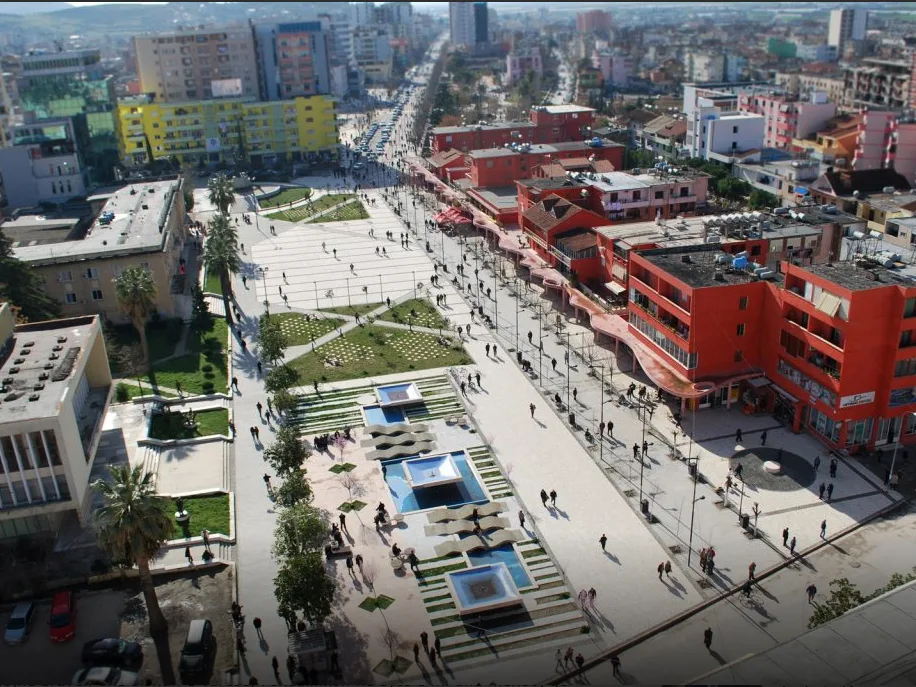
Lushnjë & Myzeqe travel guide: 1920 Congress of Lushnjë, Ardenica Monastery (Skanderbeg's wedding), Battle of Savra (1385), 85 km from Tirana.
Lushnjë (population 26,036, municipality 63,135) sits in the heart of the Myzeqe — Albania's flat central plain of olive groves, dairy farms and wetlands. The town's name is small but its role in Albanian state-building is large: between 21 and 31 January 1920, the Congress of Lushnjë at the residence of Kaso Fuga brought together 56 delegates who invalidated the rival Durrës government, formed the High and National Councils under Sulejman Delvina, and named Tirana the capital. From Tirana it is 85 km / 1 hour 15 minutes south.
Three kilometres west of Lushnjë lies the field of the Battle of Savra (1385), where the Ottomans defeated the combined Christian forces of Albania and the Balsha lords; Balsha II, the last great Balsha prince, was killed on the field. The defeat opened central Albania to Ottoman conquest. Fier, 30 km south, was founded much later — 1864 by Omer Pasha Vrioni II, the head of the powerful Vrioni Bey family — as a planned market town for the Myzeqe agricultural economy.
Then, in 1920, came the Congress of Lushnjë, one of the most consequential political meetings in Albanian history. With the country fractured between competing Italian, Greek, Yugoslav and rival Albanian factions, the 56 Lushnjë delegates established a single national government, named Tirana the capital, and laid the foundation for the principles that the country would (eventually) adopt.
The Congress of Lushnjë Museum in the centre of town occupies the original meeting house and presents the documents and biographies of the 1920 delegates (modest entry, daylight hours).
The single must-see in the region is the Ardenica Monastery, 18 km west of Lushnjë on a hill above the Myzeqe plain. Founded in the 13th century by Byzantine emperor Andronikos II, the monastery preserves a 13th–18th century iconographic programme; according to local tradition, Skanderbeg married Donika Arianiti here in 1451. Entry is around 100 Lek; a small refectory at the monastery serves traditional food. The atmosphere — frescoed walls, cypress courtyard, panoramic Adriatic views from the porch — is among the most peaceful in central Albania.
For nature, the Divjakë-Karavasta National Park is 30 minutes west; for archaeology, Apollonia is 45 minutes south.
Myzeqe cooking is built around the plain: fërgesë with peppers, tomatoes and white cheese; vegetable byrek with leeks or wild greens; pula me rosnice (chicken stew with hand-rolled dough drops); grilled sea bass or shrimps brought up from the Karavasta and Patok lagoons. Local yogurt, honey and white cheese are excellent. The regional wine to ask for is Vlosh, a fruity red from the Vlora hills further south.
Spring (May–June) and early autumn (September) are best — fields green, lagoons full of birds, mild temperatures. From Tirana, drive 85 km / 1h15 south on the A2 motorway and SH4. Most travellers visit Lushnjë and Ardenica as a half-day stop on the way to Apollonia, Berat or the Riviera.
| Lushnjë population | 26,036 (city, 2023) |
|---|---|
| Elevation | ~10 m |
| Distance from Tirana | 85 km / 1 hr 15 min |
| Ardenica Monastery | ~100 Lek, daylight hours |
| Battle of Savra | 3 km west of Lushnjë |
| Recommended stay | Half day (with Apollonia or Berat) |
Lushnjë is most efficient as a stop on a longer south-bound itinerary. Combine with Ardenica Monastery + Apollonia for a full-day archaeology-and-Byzantium loop, or with Karavasta lagoon for nature, or pair with Berat (1 hour east) for a UNESCO add-on. Albanian Eagle Tours' Apollonia and Karavasta Lagoon full-day private tour can be customised to add an Ardenica Monastery stop on request, and the 3-day Tirana–Apollonia–Vlora city break passes directly through the Lushnjë region.
It was the 21–31 January 1920 meeting of 56 Albanian delegates that ended the post-WWI political split and created the unified national government. Tirana was named capital here.
According to local Albanian tradition, yes — he married Donika Arianiti at Ardenica in 1451. The historical record is partial but the monastery preserves the tradition prominently.
For most travellers, no — but as a half-day stop on the way to Apollonia, Karavasta or Berat, it is a meaningful addition. The Congress museum and Ardenica Monastery together take 2–3 hours.
From Lushnjë, drive 18 km west on the SH4. Public buses don't reach the monastery directly; use a taxi (~€10 round trip) or include it on a guided private day tour.
Between 21 and 31 January 1920, 56 delegates from across Albania met at the residence of Kaso Fuga in Lushnjë. The country was in fragments: Italy occupied parts of the south, Yugoslavia had military presence in the north, the Greek-aligned Republic of Northern Epirus had recently collapsed, and a rival pro-Italian government in Durrës claimed legitimacy. The Lushnjë Congress invalidated the Durrës government, established a four-member High Council (Këshilli i Lartë) as a collective head of state, formed a National Council as parliament, and named Sulejman Delvina prime minister. Most consequentially, it named Tirana the capital. The decisions held: when Albania was admitted to the League of Nations in December 1920, it was on the basis of the Lushnjë framework. The original meeting house is preserved as a small museum.
Founded in 1282 by Byzantine emperor Andronikos II Palaeologus, Ardenica Monastery sits on a 230-metre hill 18 km west of Lushnjë with a panoramic view across the Myzeqe plain to the Adriatic. Local tradition holds that Skanderbeg married Donika Arianiti here on 21 April 1451; the monastery's Saint Triada church preserves frescoes of various dates from the 13th to the 18th centuries, including work attributed to the Onufri school. The atmosphere — cypress courtyard, fresco-darkened chapel, panoramic balcony — is among the most peaceful in Albania. Entry around 100 Lek; the small refectory serves traditional Myzeqe lunches by arrangement.
Three kilometres west of Lushnjë, on a flat field that today carries a small monument, the Battle of Savra (1385) ended the independent Christian kingdoms of the western Balkans as effective military powers. The Ottomans defeated the combined forces of the Albanian Balsha lords; Balsha II was killed on the field. The defeat opened central Albania to Ottoman conquest and is generally regarded as the moment the country's late-medieval political order collapsed.
Lushnjë and its surrounding sites — Ardenica, Apollonia, Karavasta, the Battle of Savra field — are too dispersed for efficient public-transport visits. Most travellers see the region as a half-day or full-day stop on a longer southbound itinerary. Albanian Eagle Tours can include the Congress of Lushnjë museum and Ardenica Monastery as additions to the standard Apollonia and Karavasta Lagoon full-day private tour from Tirana.
The Myzeqe is Albania's largest contiguous agricultural plain — roughly 1,300 km² between the Adriatic, the Shkumbin and the Vjosa. It is the country's main producer of olive oil, dairy, watermelon and stone fruit. Many small olive-oil producers welcome visits with prior arrangement, and the autumn olive harvest in October is one of the country's most photographable rural scenes. The Myzeqe was reclaimed from extensive marshlands by communist-era drainage projects in the 1950s and 1960s; the post-1990 reorganisation of land ownership returned plots to former families, and small-scale family farms now dominate. For travellers who want a deeper rural Albania experience than the standard UNESCO-and-beach circuits, a half-day Myzeqe loop with stops at a small olive mill, a farm-cheese producer and Ardenica Monastery is one of the most rewarding cultural experiences in the country.
Lushnjë and Fier together cover most accommodation needs in the region — mid-range hotels in both towns run €40–70 per night with breakfast. For a more atmospheric overnight, several agritourism farms in the Myzeqe villages between Lushnjë and Fier offer rooms in restored stone houses with farm-table dinners (€60–100 per night, dinner included); these often book up in advance during weekends. Restaurant Mrizi i Zanave in Fishtë (1 hour north near Lezhë) is the best-known agritourism address in Albania but requires reservation; closer to Lushnjë, smaller producers along the SH4 offer simpler farm tables for €15–25 per person. The classic Myzeqe meal opens with white cheese and olives, advances to lakror (the multi-greens layered pie), centres on chicken or sea bass with rice, and finishes with gliko and Turkish-style coffee.
See central Albania's heart. Add Lushnjë and Ardenica to a private Apollonia & Karavasta full-day tour with Albanian Eagle Tours.
🗺 Central Albania — Explore Nearby
Each destination is reachable by private Car & Driver from Tirana. View all organised tours →
Plan your visit to Lushnje Region
How it works
Plan Your Visit to Albania
Choose how you want to explore
Listen to this destination's audio tour free — or book a private guided experience.
Open Audio Tour Book a Guided Tour