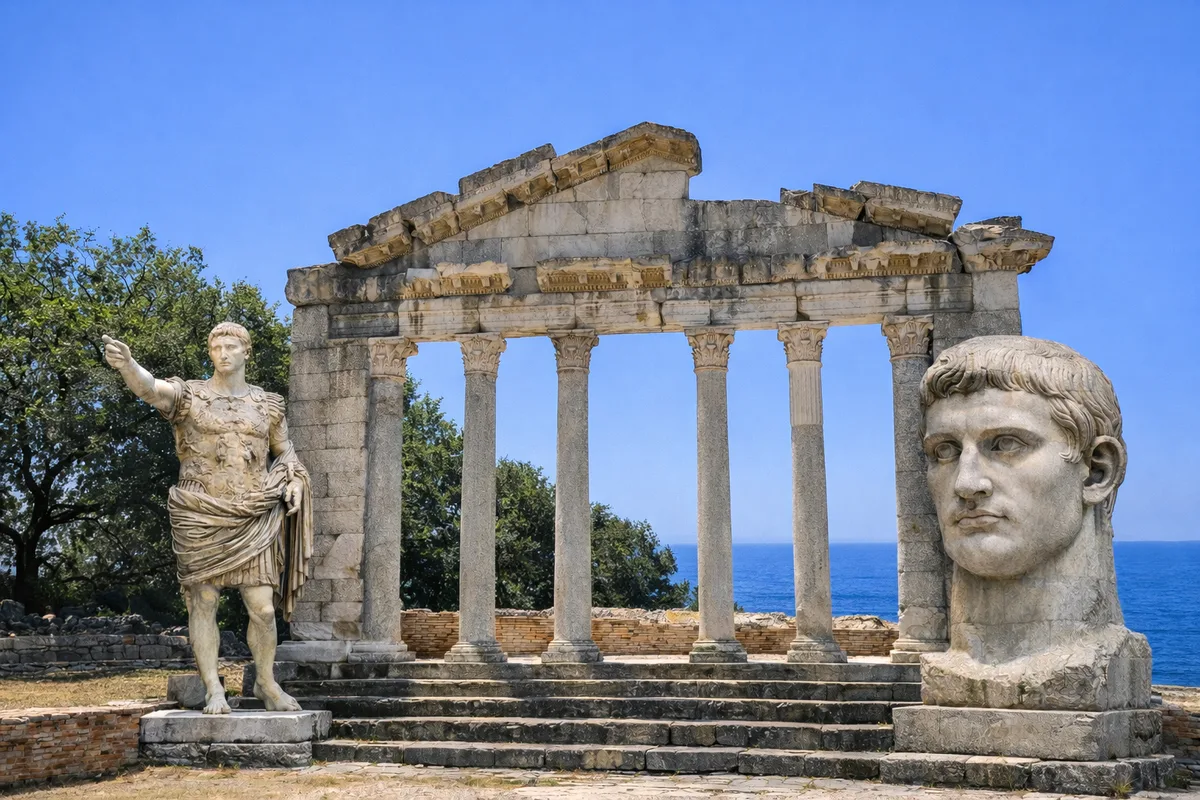
Apollonia Archaeological Park: founded 588 BC by Gylax, Octavian (Augustus) studied 44 BC, 7,000-seat theatre, Bouleuterion, 600 ALL entry, 130 km Tirana.
Apollonia is the ancient Greek city, founded around 600 BC by Greek colonists from Corinth and Corfu under the leader Gylax, that became one of the most important commercial centres on the eastern Adriatic — and where, in 44 BC, the 18-year-old Octavian (the future Augustus) was studying philosophy and rhetoric when news arrived of Julius Caesar's assassination. The site, abandoned by the 4th century AD after a 3rd-century earthquake silted its harbour, sits on a hilly plateau ~250 m above the modern Vjosa Valley, 130 km / 2–2.5 hours south-west of Tirana.
The colony was originally called Gylakeia after its founder Gylax; it was renamed Apollonia in 588 BC after the god Apollo. By the Hellenistic period the population may have reached 60,000 — making it one of the largest Greek cities on the Adriatic. The famous Aristotle reference (in his Politics) describes Apollonia's mixed Greek-and-Illyrian governance as a model of moderate oligarchy.
The city's most-told story is its role in the rise of Rome's first emperor. In 44 BC, the young Octavian — Caesar's adopted son and great-nephew — was completing his education at Apollonia under the philosopher Athenodorus of Cana. Word reached him on 23 March of the previous Ides — and within weeks he had crossed the Adriatic, claimed Caesar's name, and begun the political journey that would make him Augustus 17 years later.
Apollonia's earlier military history includes the c. 450 BC defeat of the Amantes tribe at Thronion, which the city commemorated by erecting a victory monument at Olympia. Roman control dates from 229 BC. The end was geological: the 3rd century AD earthquake diverted the Vjosa River, silting the harbour and effectively cutting the city off from its sea trade. By the 4th century AD the site was abandoned. UNESCO added Apollonia to its Tentative List in 2014.
The site is large but compact — most key monuments lie within a 30-minute walking circuit. Highlights:
Park hours: May–October 09:00–19:00 daily; November–April 09:00–16:00 Tuesday–Sunday (closed Mondays). Entry: 600 ALL (~€6) for adults, free for children 0–12, discounts for students and visitors with disabilities. Allow 2–4 hours.
The Myzeqe plain around Apollonia produces a distinctive multi-greens lakror — a thin layered pie made with up to 12 varieties of wild greens collected in spring. The wine of the immediate region is Vlosh, a fruity red from the Vlora hills nearby; Shesh i Zi is also widely served. Restaurants are limited at the site itself; most visitors eat in Fier (15 km), Lushnjë or Vlora.
Spring (March–May) and autumn (September–October) are best — wildflowers in spring, golden grasses in autumn, and 18–28 °C temperatures with no shade on the plateau. Most visitors come on a half-day or full-day trip from Tirana, often combined with the Karavasta lagoon. Allow 2–4 hours on site.
| Founded | ~600 BC by Gylax (renamed Apollonia 588 BC) |
|---|---|
| Peak population | ~60,000 (Hellenistic) |
| Octavian studied here | 44 BC |
| Distance from Tirana | ~130 km / 2–2.5 hr |
| Entry | 600 ALL (~€6) |
| Hours | May–Oct 09:00–19:00 daily; Nov–Apr 09:00–16:00 Tue–Sun |
| Recommended stay | 2–4 hours on site (half/full day from Tirana) |
The most popular single-day combination is Apollonia + Karavasta Lagoon from Tirana — ancient Greek city in the morning, Adriatic-pelican wetland in the afternoon. Albanian Eagle Tours' Apollonia and Karavasta Lagoon full-day private tour covers exactly this route, with a guide who can explain both the Hellenistic urban plan and the lagoon ecology. For a longer combination, the 3-day Tirana–Apollonia–Vlora private city break adds Albania's first capital, while the 6-day Classic Albania tour integrates Apollonia into a country-wide loop with Berat (UNESCO, 1 hour east) and the Riviera.
Yes — for travellers interested in Greek and Roman history, this is the most important Hellenistic site in Albania apart from Butrint. The Bouleuterion façade alone justifies the trip.
The 600 ALL ticket covers the archaeological park including the museum inside the St. Mary Monastery. Audio guides and human guides are available at the entrance for an extra fee.
Yes. He arrived in 45 BC and was completing his education with the philosopher Athenodorus when news of Caesar's assassination on 15 March 44 BC reached him here. He sailed to Italy soon after to claim his inheritance.
Drive from Tirana to Apollonia (2–2.5 hours), spend 2–3 hours on site, lunch in Fier or near the lagoon, then 1.5 hours at Karavasta with a Pelican Trail walk before driving back to Tirana. Albanian Eagle Tours runs this exact itinerary as a private full-day tour.
The 18-year-old Gaius Octavius — Caesar's grand-nephew and adopted heir, soon to become Augustus — was completing his education at Apollonia in early 44 BC, studying philosophy and rhetoric with the philosopher Athenodorus of Cana. Caesar had nominated him to be his second-in-command on the planned Parthian campaign. On 23 March 44 BC, news reached Apollonia that Caesar had been assassinated in Rome on the Ides of March (15 March). The young Octavian was urged by some to seek refuge with the Macedonian legions stationed nearby; instead he sailed for Brundisium (Brindisi) within weeks, claimed Caesar's name and political inheritance, and began the political career that would make him the first Roman emperor 17 years later. The story is told by Suetonius, Plutarch, Cassius Dio and Velleius Paterculus — Apollonia is one of the few places in the western Mediterranean named in all four major ancient sources for this single moment.
The Bouleuterion — the council building of Apollonia — is the city's most photographed monument: a six-column Corinthian façade reconstructed in the 1930s by Italian archaeologists. The original 2nd-century AD building housed the boule (city council) of around 200 men; behind the façade lay a covered hall with stepped seating. Adjacent stand the smaller Odeon (a roofed concert hall with about 300 seats) and the much larger Hellenistic theatre (originally seating 7,000), partly excavated. The Stoa — a long colonnaded portico — defined the upper city's public space and connects the major monuments.
The 13th-century St. Mary Monastery sits inside the ancient city walls — built on Roman foundations using reused Hellenistic stone. The church preserves Byzantine frescoes including a large Last Judgement; the surrounding monastic buildings now house the Apollonia Archaeological Museum, with statues, mosaic fragments, busts and inscriptions excavated on site since the 1920s. Highlights include a series of marble portraits of Hellenistic and Roman magistrates, fragments of the Olympic victory monument the city erected to mark the c. 450 BC defeat of Thronion, and the surviving Roman mosaic floor sections from the city villas.
Apollonia's monuments are spread across a 30-hectare site with limited English signage. Without a guide, the Bouleuterion façade is photogenic but the layered story — Greek colonisation 600 BC, the c. 450 BC Thronion victory, Octavian in 44 BC, Roman colonia status, the 3rd-century earthquake, the 4th-century abandonment — is hard to assemble. Albanian Eagle Tours' Apollonia and Karavasta Lagoon full-day private tour from Tirana includes a guide who can read the inscriptions and walk you through the urban plan. For travellers wanting Apollonia within a longer itinerary, the 3-day Tirana–Apollonia–Vlora private city break places it as the historical anchor between the modern capital and Albania's first capital.
Stand where Augustus heard the news. Book the Apollonia & Karavasta Lagoon full-day private tour with Albanian Eagle Tours.
🗺 Archaeological — Explore Nearby
Each destination is reachable by private Car & Driver from Tirana. View all organised tours →
Plan your visit to Apollonia
How it works
Plan Your Visit to Albania
Choose how you want to explore
Listen to this destination's audio tour free — or book a private guided experience.
Open Audio Tour Book a Guided Tour