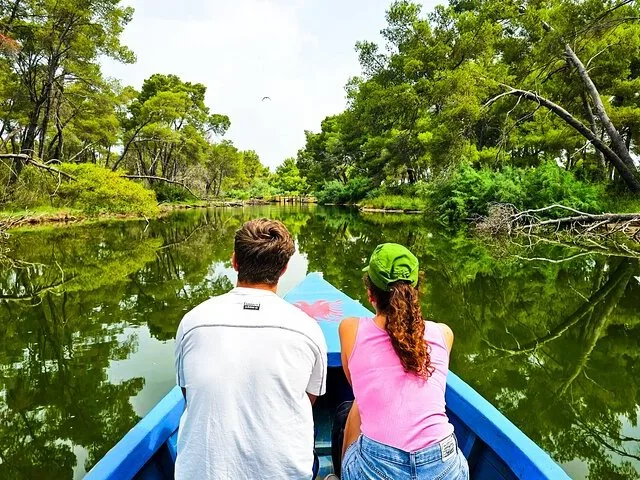
Divjakë-Karavasta travel guide: 222 km² Ramsar wetland (1995), Dalmatian pelicans (only Adriatic colony), Pelican Trail, pine forests, 1h40 from Tirana.
Divjakë-Karavasta National Park stretches for 222 km² along Albania's central Adriatic coast — a mosaic of pine forest, sand spit, brackish lagoon and beach that holds the only breeding colony of Dalmatian pelicans (Pelecanus crispus) on the Adriatic. Designated a Ramsar wetland in 1995 and protected in various forms since 1964, Karavasta is one of southern Europe's most important wetland reserves. From Tirana it is 84–90 km / 1 hour 40 minutes via the Durrës–Fier highway.
The Karavasta colony is the southernmost regular Dalmatian pelican breeding site outside the Black Sea — perhaps 70–100 breeding pairs in good years. The pelican has been the symbol of the park since it became a protected territory in 1964 and a Ramsar site in 1995. The western edge of the lagoon is closed by a 25-kilometre sand spit, the longest natural barrier beach on the Albanian coast.
The park's most-discussed recent moment was the May 2017 announcement by the Kosovo-Albanian construction firm Mabetex (Behgjet Pacolli) of a 1,170-hectare urban development covering high-rises and 4,300 hotel beds. The plan was strongly opposed by environmental NGOs, ornithologists and EU monitors, and remains the central political question over the park's long-term future.
The park has no entry fee and no formal opening hours — most travellers arrive any time during daylight. Two main trails leave from the visitor area near Divjakë town:
Climb the wooden bird hides at Skela e Pirgut for the panoramic lagoon view; binoculars essential. Boat trips on the lagoon can be arranged through restaurants in Divjakë town (€10–25 per person, summer mainly). The 25-km sand spit beach itself has free public swimming areas — the section near the visitor centre is the easiest access.
In autumn, look for migrating greater flamingos, spoonbills and pygmy cormorants; in winter, large flocks of waterfowl. The park is also one of the few places in Albania to spot red deer in the pine forest at dusk.
The lagoon supplies the kitchen — sea bass, mullet, eels and shrimps fished daily. Ali Kali, on the Karavasta lagoon edge, is the long-standing local seafood restaurant; Divjaka Fish Restaurant nearby is a more recent alternative. Expect simple grilled fish, salad, fries and house white wine for €10–15 per person. The local olive oil from the Myzeqe plain inland is excellent; ask for it on the side.
Spring (March–May) and autumn (September–November) are best — pelican breeding, flamingo migration, mild 12–24 °C. Summer is workable but hot and the pine-forest mosquitoes can be relentless after dusk. Most visitors plan 2–3 hours on a half-day trip from Durrës or Berat; nature lovers spend a full day, picnicking on the spit. From Tirana, the 1h40 drive makes Karavasta a comfortable day trip.
| Park area | 222 km² |
|---|---|
| Designation | Ramsar wetland 1995; National Park 2007 |
| Distance from Tirana | 84–90 km / 1 hr 40 min |
| Entry fee | None |
| Pelican Trail | 3.3 km / 30 min |
| Best time | Spring & autumn |
| Recommended stay | Half day to full day |
Karavasta sits 15 minutes south of Lushnjë, 30 minutes north of Fier and Apollonia, and 90 minutes from Berat. The most efficient day combines Apollonia (morning, 2 hours), lunch at the Karavasta lagoon edge, and the Pelican Trail (afternoon). Albanian Eagle Tours' Apollonia and Karavasta Lagoon full-day private tour covers exactly this combination from Tirana — it is the easiest single-day way to see both UNESCO-tentative archaeology and the Adriatic's most important wetland in one trip.
Yes — Dalmatian pelicans breed here every year in small numbers. The best chance of seeing them is early morning between April and June from the bird hides at Skela e Pirgut.
The Adriatic-side beach on the sand spit is excellent for swimming — clean, gently shelving water and wide pine-backed sand. The lagoon itself is brackish and not used for swimming.
No, the trail is signposted and easy. A guide is helpful for serious birdwatching — local naturalists from the visitor centre know exactly where the pelican family is feeding on a given day.
Yes, that is the most popular itinerary — Apollonia in the morning, Karavasta lunch and Pelican Trail in the afternoon, back to Tirana for dinner.
The lagoon's bird year runs in three phases. March–June is breeding season for the Dalmatian pelicans — the small colony nests on a reed island in the central lagoon, best viewed at dawn from the Skela e Pirgut hide with binoculars. September–November brings migrating greater flamingos, often in flocks of several hundred, plus spoonbills, glossy ibis and pygmy cormorants. December–February is the waterfowl season — large flocks of teal, wigeon, pochard and the rare ferruginous duck. The lagoon hosts more than 250 recorded bird species across the year. Pack binoculars (8x or 10x), a long lens for photography, and a thermos of hot drink for the dawn hides.
The Pelican Trail (Shtegu i Pelikanit) is 3.3 km, signposted, mostly flat, with three viewpoint platforms over the lagoon and a series of interpretive panels. Allow 30–45 minutes including stops. The trail starts at the visitor centre near Divjakë town. The Tajga Trail is 2.7 km, also signposted, looping through dense pine forest with quieter wildlife encounters — boar tracks are common, red deer occasionally visible at dawn or dusk. Both trails are free and open year-round. Guided naturalist walks can be arranged through the visitor centre for around €20–40 per group.
The 25-kilometre sand spit on the Adriatic side of the lagoon is one of Albania's longest natural beaches. The section near the visitor centre has rough access via a forest road; bring a 4x4 or expect a 30-minute walk through the pine. Once on the beach, you'll often have the place to yourself outside July–August. The water is clean and the wading is gentle. Pack a picnic — there are no facilities once you leave the village.
Apollonia and Karavasta sit 30 minutes apart and are best done together. A typical guided day from Tirana: depart 08:30, Apollonia 11:00–13:30 (with a guide who can read the inscriptions and explain Octavian's 44 BC moment), lunch at Ali Kali on the lagoon edge (lagoon fish, €15 per person), Pelican Trail afternoon, return Tirana for late dinner. Albanian Eagle Tours' Apollonia and Karavasta Lagoon full-day private tour follows exactly this route.
In May 2017 the Kosovo-Albanian construction firm Mabetex, owned by the businessman and politician Behgjet Pacolli, announced a 1,170-hectare urban development to cover part of the Karavasta protected area — high-rise hotels, a marina and reportedly 4,300 hotel beds. The plan attracted strong opposition from Albanian and international environmental NGOs, the EU's environmental monitoring framework and the Ramsar Convention secretariat, on the grounds that it violated both national and international protections of the wetland. As of 2024 the project remains stalled, but the political pressure for coastal development continues, and the long-term protection of Karavasta is widely seen as a test case for whether Albania's tourism boom can be reconciled with its UNESCO and Ramsar commitments. For independent travellers, the practical message is simple: visit now, on small footprint, and support the operators (small lagoon-edge restaurants, naturalist guides) whose livelihoods depend on the park staying as it is.
Karavasta is straightforward to visit but rewards a few small preparations. Bring binoculars (8×42 is the standard birdwatching size), a small daypack with water and snacks, and insect repellent for the spring and autumn shoulder seasons when mosquitoes are active near the lagoon edge. Wear closed shoes for the Pelican and Tajga trails — both have occasional muddy patches in spring. The visitor centre has limited facilities (a small cafe, basic toilets) and most signage is bilingual Albanian and English. Photographers should pack a long lens (300 mm minimum for serious bird shots); the Skela e Pirgut hide gives the closest reliable views of the pelican colony. For travellers driving down from Tirana, the most efficient day starts at 08:00 from Tirana, reaches the visitor centre by 10:00 and combines the morning Pelican Trail with an Apollonia afternoon (30 minutes south) before returning for late dinner in Tirana.
See Albania's pelicans and Apollonia in one day. Book the Apollonia & Karavasta Lagoon full-day private tour with Albanian Eagle Tours.
🗺 Central Albania — Explore Nearby
Each destination is reachable by private Car & Driver from Tirana. View all organised tours →
Plan your visit to Divjakë & Karavasta Lagoon
How it works
Plan Your Visit to Albania
Choose how you want to explore
Listen to this destination's audio tour free — or book a private guided experience.
Open Audio Tour Book a Guided Tour