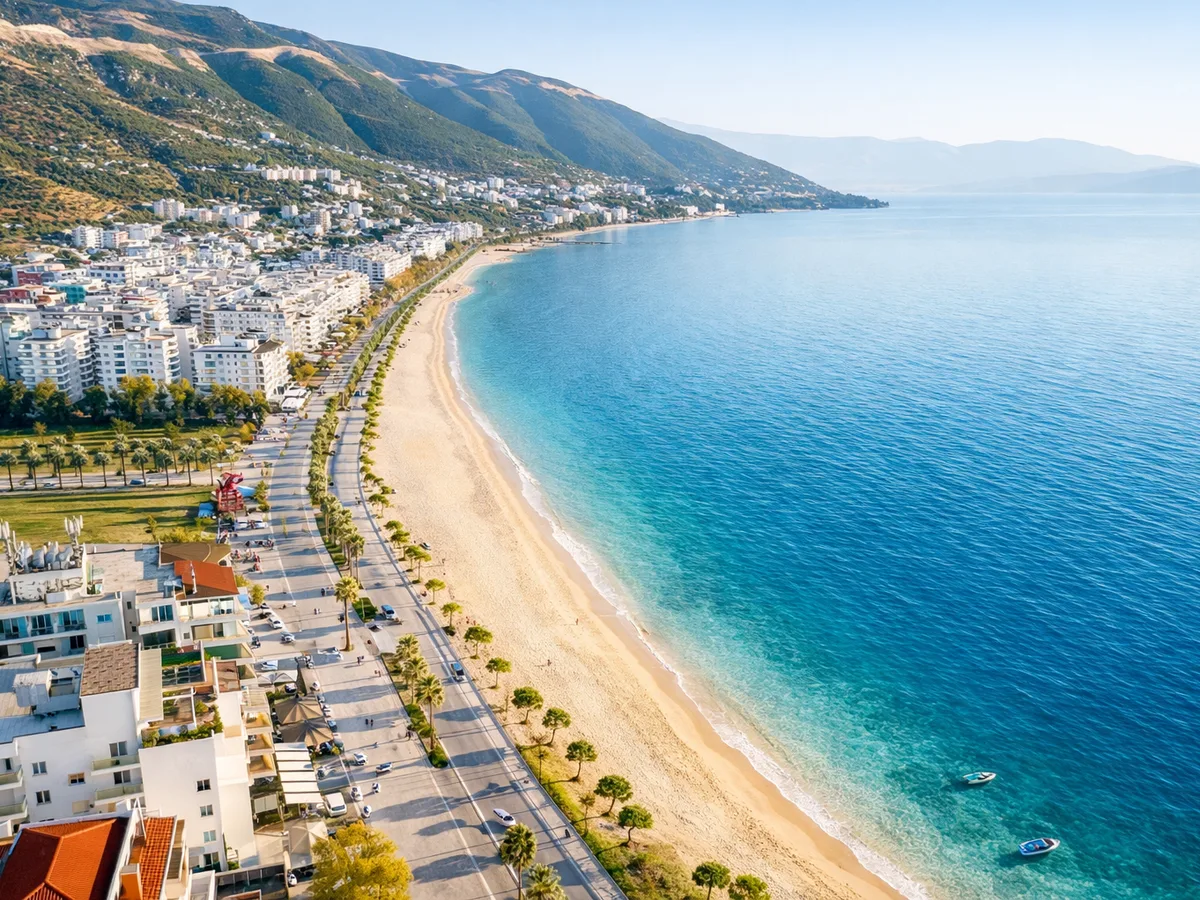
Vlora travel guide: 1912 Independence (Ismail Qemali), Muradie Mosque (1542), Zvërnec monastery, Sazan-Karaburun boat tours (€30–80), 2.5 hr from Tirana.
On 28 November 1912, in a two-storey wooden house on what is now Flag Square, Ismail Qemali read out the Declaration of Independence — Albania's first proclamation as a sovereign state, with Vlora as its first capital. The city (population 66,320) sits at the precise point where the Adriatic narrows into the Strait of Otranto and where the limestone Karaburun peninsula rises straight from the sea. From Tirana it is 150 km / 2.5–3 hours down the A2 motorway and SH8.
Vlora is among the oldest urban sites on the Albanian coast — fortified port activity at Triport dates to the 6th century BCE, with Illyrian remains from the 11th–10th centuries BCE. From 1346 to 1417 it was the capital of the independent Christian Principality of Valona, a small but stable statelet whose princes married into Byzantine and Serbian noble families before the Ottomans took the city in 1417. Albanian rebels briefly expelled them in 1432.
Under the Ottomans, Vlora became one of the empire's most cosmopolitan ports. Ottoman census records show 528 Jewish families in 1506 and around 2,600 Jews in 1520, the community boosted by Sephardic refugees expelled from Spain after 1492. The Muradie Mosque (1542), designed by Mimar Sinan — the imperial architect of Suleiman the Magnificent — is the southernmost surviving Sinan work in the western Balkans and one of the very few mosques in Albania attributed to him.
Twentieth-century Vlora has stayed politically central. After 1912, the city was capital until the government moved to Durrës; in 1961 Soviet forces threatened occupation over a dispute about the Pasha Liman naval base, helping precipitate Hoxha's split with Moscow.
Start at Flag Square with the Independence Monument and the National Museum of Independence (housed in the original 1912 building, ~300 ALL / €3, Tue–Sun 09:00–17:00). Climb the small Kuzum Baba hill for the panoramic city-and-bay view (free). The Muradie Mosque is open free outside prayer times — modest dress requested.
Drive 12 km north to Zvërnec Island in the Narta Lagoon — a wooden footbridge crosses to a tiny pine-covered island whose 14th-century Byzantine monastery contains surviving frescoes. Open roughly 08:00–20:00 May–November, donations requested. The lagoon itself is one of Albania's best flamingo-watching sites in autumn.
For a half day inland, Kanina Castle (4th century BC Illyrian foundations, free, panoramic) sits on a 380-metre ridge directly above the city. For a full day, take a Sazan Island and Karaburun peninsula boat tour — Sazan was a Cold War Soviet/Albanian naval base, only opened to civilian visits after 2015, and the Karaburun coast is a sequence of sea caves (Haxhi Ali Cave, Pirate's Cave) only accessible by boat. Tours run from Vlora's Old Beach for €30–80 per person depending on group size and length, summer only.
For swimming, Vlora's town beaches are crowded; drive south 20 minutes to Radhime for clearer water and quieter sand.
Vlora belongs to the Labëria region of southern Albania, with its own polyphonic music tradition (UNESCO Intangible Heritage) and a coast-meets-mountain table. Order grilled sea bass, octopus salad and the local tavë kosi with lamb. The fish restaurants at the Old Beach (Kafe Bar Pasha, Restaurant Skela) are reliable. Finish with rakia distilled from the inland Vlora hill grapes.
May, June and September are best — 22–30 °C, the sea is warm and prices are lower than peak summer. From Tirana, the A2 motorway and SH8 take 2.5–3 hours; intercity buses and furgon minibuses run several times daily for around 800 Lek. Plan 2–3 days: city and Zvërnec on day 1, Karaburun boat on day 2, Llogara and Riviera onward on day 3.
| City population | 66,320 (2023) |
|---|---|
| Elevation | 0 m (sea level) |
| Founded | 6th century BCE (Triport) |
| Distance from Tirana | 150 km / 2.5–3 hr |
| Independence Museum | ~300 ALL, Tue–Sun |
| Sazan/Karaburun boat | €30–80, summer |
| Recommended stay | 2–3 days |
Vlora is the natural transition point between the central Albanian plain (Apollonia, Berat) and the Ionian Riviera (Llogara, Dhërmi, Himarë). Albanian Eagle Tours' 3-day Tirana–Apollonia–Vlora private city break uses Vlora as its southern climax; the 6-day Classic Albania tour stops in Vlora before crossing the Llogara Pass to the Riviera. Couples and small groups looking for a two-coast itinerary should ask about combining a Vlora night with a Karaburun boat day.
It is where Ismail Qemali declared Albanian independence on 28 November 1912 and where the country's first government was formed. The original wooden house is now the National Museum of Independence.
Yes, since 2015. Day boat tours from Vlora's Old Beach run May–October and include landing on Sazan plus the Karaburun sea caves. Bring a passport — it is checked on arrival.
The town beaches themselves are crowded. Better swimming is at Radhime (20 minutes south) and over the Llogara Pass on the Riviera. For history-plus-beach, Vlora is unbeatable.
The A2 motorway and SH8 take 2.5–3 hours by car. Direct furgon minibuses run from Tirana's South Terminal for around 800 Lek and take 3 hours.
The narrative of Albanian independence is compressed into a few weeks of November 1912. By that month the First Balkan War had effectively shattered Ottoman authority in the western Balkans; Ismail Qemali, an Ottoman-trained Albanian statesman who had served in the imperial administration, led a delegation that travelled overland and by sea to Vlora. On the morning of 28 November 1912 — chosen to commemorate the day Skanderbeg raised his flag at Krujë in 1443 — Qemali read out the Declaration of Independence from the balcony of a two-storey wooden house on the central square. The same square hosted the formation of Albania's first government later that day. The flag of independence — the double-headed black eagle on a red field — became the national symbol, taken directly from Skanderbeg's banner. The original house is now the National Museum of Independence, restored exactly to its 1912 condition; the chairs, table and inkwell are originals.
Sazan Island, 12 km offshore, was a closed Soviet (and later Albanian) naval base from 1947 onward, with a chemical-weapons stockpile reported during the Hoxha era. The base only opened to civilian visits in 2015. Boat tours from Vlora's Old Beach run May through October for €30–80 per person, depending on group size and trip length. Most include a 2-hour stop on the island (the abandoned barracks, the Soviet-built mess hall, the underground tunnels) plus the Karaburun peninsula sea caves on the return — Haxhi Ali Cave (the largest, named after a 19th-century pirate) and the Pirate's Cave with its emerald light. Bring a passport — it is checked on arrival.
Twelve kilometres north of Vlora, a wooden footbridge crosses the Narta Lagoon to Zvërnec Island — a tiny pine-covered islet with the 14th-century Byzantine Saint Mary Monastery. The monastery is open roughly 08:00–20:00 May–November; donations are welcomed. The Narta Lagoon itself is one of the country's best birdwatching wetlands, especially for autumn flamingos. Combine with lunch at one of the lagoon-edge fish restaurants for a relaxed half-day.
Vlora's two big themes — the 1912 independence story and the Karaburun-Sazan Cold War coast — both benefit from English-language context that the small museums and the Sazan boat operators don't always provide. Albanian Eagle Tours' 3-day Tirana–Apollonia–Vlora private city break uses Vlora as the climactic stop on a route that begins with the capital and the Greek-Illyrian ruins at Apollonia — a logical historical arc.
Vlora belongs to the Labëria region of southern Albania, home to one of the oldest continuous polyphonic singing traditions in Europe. UNESCO inscribed Albanian iso-polyphony on its Representative List of the Intangible Cultural Heritage of Humanity in 2008. The Lab style typically involves four parts — a soloist, two answering voices and a drone choir holding a single sustained note ("iso") — and the songs typically narrate historical events, emigration, weddings or laments. Live polyphonic performances are most reliably heard at Vlora's annual cultural festivals or at small folk-music restaurants in the surrounding villages. A guided tour of the Vlora region can include a stop at a polyphonic singing session by prior arrangement.
Visit Albania's first capital. Book the 3-day Tirana–Apollonia–Vlora city break with Albanian Eagle Tours.
🗺 South Albania — Explore Nearby
Each destination is reachable by private Car & Driver from Tirana. View all organised tours →
Plan your visit to Vlorë
How it works
Plan Your Visit to Albania
Choose how you want to explore
Listen to this destination's audio tour free — or book a private guided experience.
Open Audio Tour Book a Guided Tour