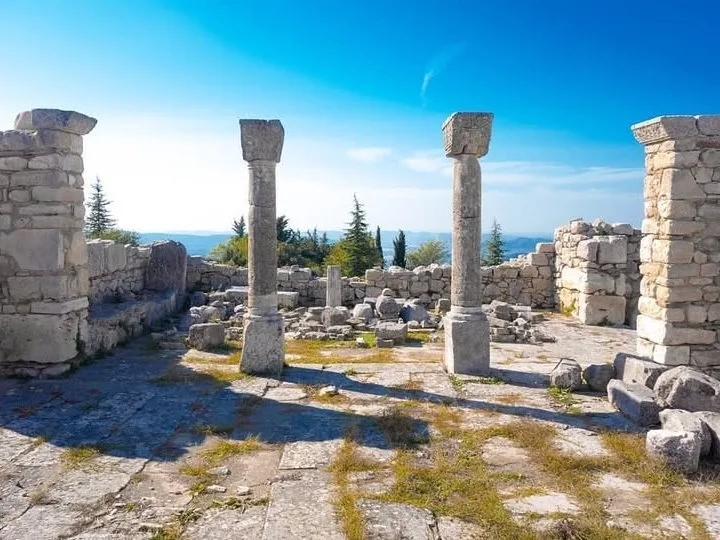
Byllis Archaeological Park: 30 ha Hellenistic city (founded 350 BC), 7,500-seat theatre, Justinian walls, mosaic basilicas, 400 ALL entry, 120 km from Tirana.
Byllis sits at 547 metres on a flat-topped acropolis above the Vjosa River — a 30-hectare Hellenistic city, founded around 350 BC, with one of the largest preserved theatres on the Adriatic coast. It became Albania's first Archaeological Park (declared 7 April 2003) and remains one of the country's most visually impressive ancient sites — visited by a fraction of the crowds at Apollonia or Butrint. From Tirana, allow 120 km / 2 hours via Fier and Ballsh.
The city's history is a sequence of quick reversals. Cassander of Macedon conquered Byllis in 314 BC; Glaukias of Illyria recaptured it in 312 BC; Philip V of Macedon held it 213–198 BC; the Romans sacked it in 169/168 BC after it allied against them. By Roman imperial times, Byllis was a flourishing provincial city of the Province of Epirus Nova, and in 431 AD Bishop Felix of Byllis attended the Council of Ephesus — a clear marker of its early Christian importance.
The walls visitors see today were rebuilt by the Byzantine engineer Victorinus under Justinian I (527–565 AD); an inscription on the eastern stretch records his work. The end came with the Slavic invasions of 586 AD, after which the city was abandoned and never rebuilt — leaving the Hellenistic and early Christian fabric exceptionally well preserved.
The site occupies a single acropolis ringed by 2.25 kilometres of walls with six gates. The standout monument is the Hellenistic theatre, with seating originally for an estimated 7,500 spectators — one of the largest in the western Balkans. Adjacent are the stadium (largely buried but with visible starting blocks), the agora with surviving stoa colonnades, the great cistern and a peristyle temple. From the late Roman and early Christian period, the site preserves several basilicas with mosaic floors (some uncovered for visitors, others kept under sand for protection), and the episcopal complex at the east end.
Byllis Archaeological Park opens daily 09:00–19:00 in May–October; Tuesday–Sunday 09:00–16:00 in November–April (closed Mondays). Entry is 400 ALL individual (~€4), with discounts for groups and students. Allow 2–4 hours on site; the panoramic Vjosa valley views make Byllis worth visiting even without the archaeology.
The Mallakastra district around Byllis is rural Albanian wine and olive country. Order vegetable or meat byrek, lamb roasts, tavë kosi, and the regional Shesh i Zi red, often grown in the same hills as the ancient site. Restaurants are clustered in Ballsh, 10 minutes' drive from the site.
May–June and September–October are ideal — wildflowers in spring, golden grasses in autumn, and 18–26 °C temperatures. Avoid July–August (heat on the exposed plateau, no shade) and December–February (mud on access road and at the site). The drive from Tirana takes 2 hours via Fier and Ballsh; allow half a day to a full day total.
| Site area | 30 hectares |
|---|---|
| Founded | ~350 BC |
| Elevation | 524–547 m |
| Theatre capacity | ~7,500 seats |
| Distance from Tirana | ~120 km / 2 hr |
| Entry | 400 ALL (~€4) |
| Hours | May–Oct 09:00–19:00 daily; Nov–Apr 09:00–16:00 Tue–Sun |
Byllis pairs naturally with Apollonia (30 km / 40 minutes north) for an ancient-cities double-bill — the two sites are roughly contemporary, and Byllis offers the wall-and-theatre architecture that Apollonia largely lost when its harbour silted up. Berat is 1 hour east, Tepelenë 1 hour south. For travellers wanting to see Byllis on a guided basis, Albanian Eagle Tours' Apollonia and Karavasta Lagoon full-day private tour can be extended on request to add a Byllis afternoon, and the 6-day Classic Albania tour includes Byllis as an optional stop on the southbound day from Berat to Gjirokastër.
Yes, especially if you have already seen Apollonia. The walls are more intact, the theatre much larger, and the Vjosa Valley views from the acropolis are unmatched.
Most visitors spend 2–4 hours on site. The walking is moderate but the plateau is exposed to the sun — bring water and a hat in summer.
Yes — start early. Apollonia in the morning, lunch in Ballsh, Byllis in the afternoon, back to Tirana for late dinner. By private car this is a comfortable day; by public transport it is difficult.
Mostly yes; the final 2 km to the entrance is rough but normally manageable in a regular car except after heavy rain. The site has a small parking area with no facilities — bring everything you need.
Byllis was laid out in the standard Hellenistic urban grid, with insulae (rectangular blocks) defined by perpendicular streets, public buildings clustered around the agora, and the religious and theatrical buildings on the southern terrace. The walls — 2.25 km in circuit, with six gates — enclosed the entire 30-hectare plateau and were strengthened repeatedly: original 4th-century BC construction, Roman repairs, and a major Byzantine reconstruction under Emperor Justinian I (527–565 AD) by the engineer Victorinus. A Greek inscription on the east wall records Victorinus's work — one of the very few cases where we know by name the engineer responsible for a late-antique fortification.
Enter through the modern visitor gate and walk first to the Hellenistic theatre on the southern terrace — original capacity 7,500, with a partly preserved orchestra and surviving stage building. Continue west to the stadium, where the starting blocks and finish marker are still visible. The agora with surviving stoa colonnades sits in the centre of the site; from here, walk north to the cistern complex and the peristyle temple foundations. The early Christian basilicas with mosaic floors are scattered across the eastern half of the site — Basilica A, B and C; some mosaics are uncovered seasonally for visitors. Finish at the episcopal complex on the eastern wall for the Vjosa Valley panorama. Bring water and a hat — there is no shade on the plateau.
The participation of Bishop Felix of Byllis at the Council of Ephesus in 431 AD is one of the few moments when the city enters the international Christian record by name. Ephesus was a major early-church council that condemned the Nestorian heresy; bishops from across the empire attended, including from peripheral provinces like Epirus Nova. Felix's presence indicates that Byllis was, by the early 5th century, an established Christian see with its own bishop — consistent with the multiple basilicas that survive on the site.
Byllis is poorly served by public transport — there is no bus to the gate, and the access road is rough. The site itself has limited interpretation in English. A private guide explains the chronology of the walls (Hellenistic foundations, Roman repairs, Justinian rebuild), the importance of the basilicas, and the historical context that connects Byllis to Apollonia 30 km north. Albanian Eagle Tours can integrate Byllis as an afternoon extension to the standard Apollonia full-day tour, or include it as a stop on the southbound day of the 6-day Classic Albania tour.
The end of urban life at Byllis came with the Slavic invasions of 586 AD, when Avar-led Slavic forces swept through the Balkans and destroyed many late-Roman cities. Byllis was sacked and its surviving population dispersed. Unlike many other Hellenistic-Roman sites that were partially reoccupied in later centuries, Byllis was never resettled — the city was simply abandoned to grass and stone. This is what makes it archaeologically valuable today: the urban layout has not been disturbed by medieval rebuilding, and the Hellenistic-Roman-Byzantine fabric is exceptionally clear. Excavations have continued since the 1970s under a succession of Albanian and French teams, and several of the basilica mosaics have been conserved in situ. The site remains one of the most rewarding ancient destinations in Albania for travellers who appreciate seeing a city in its pre-medieval state.
Add Byllis to your Albania archaeology trip. Customise a private tour with Albanian Eagle Tours — start with the Apollonia full-day tour or the 6-day Classic Albania tour.
🗺 Archaeological — Explore Nearby
Each destination is reachable by private Car & Driver from Tirana. View all organised tours →
Plan your visit to Byllis
How it works
Plan Your Visit to Albania
Choose how you want to explore
Listen to this destination's audio tour free — or book a private guided experience.
Open Audio Tour Book a Guided Tour