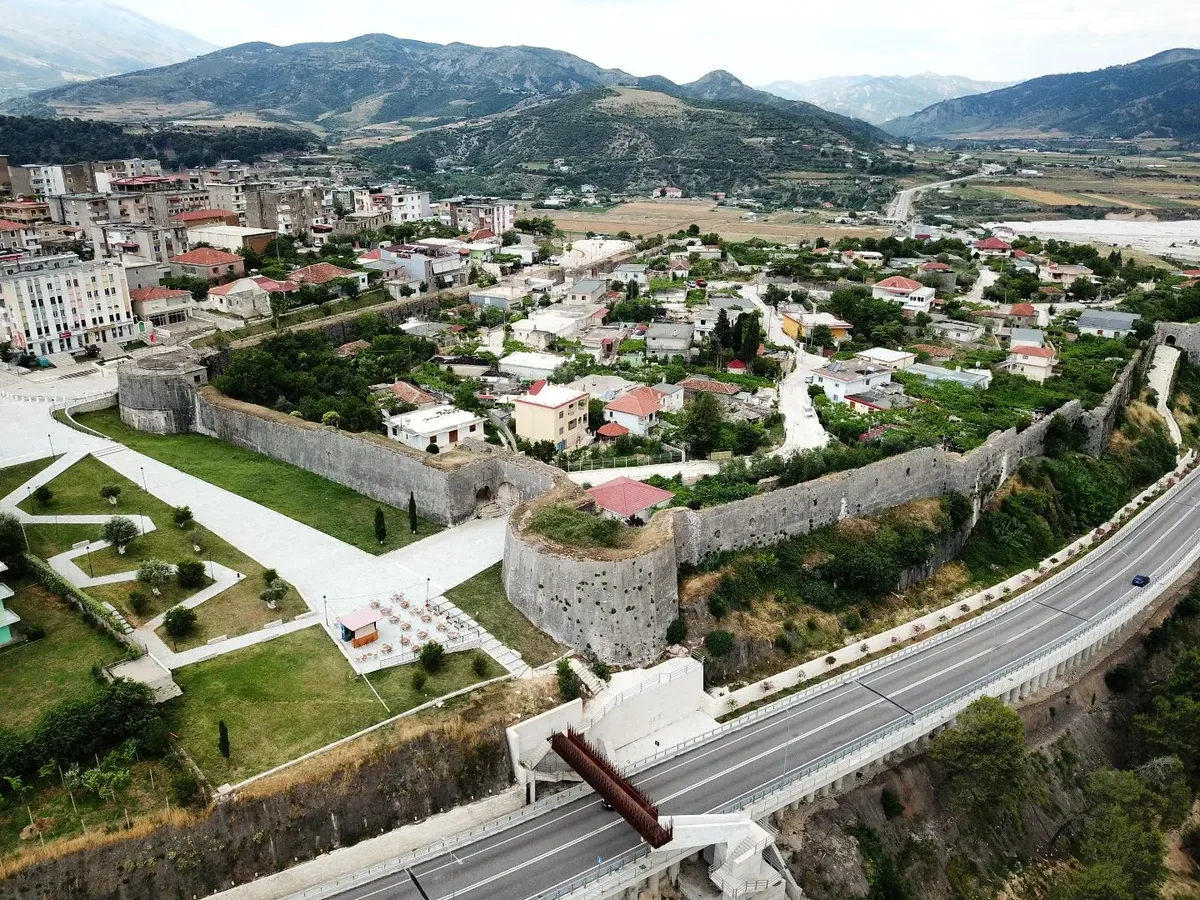
Tepelenë travel guide: Ali Pasha (1740–1822), Lord Byron's 1809 visit, Vizier Gate (1819), Tepelena Castle ruins, Vjosa river, 179 km from Tirana.
Tepelenë (population 6,761 in the wider municipality, the town smaller still) sits high above the Vjosa River, 179 km / 2.5–3 hours south of Tirana. Its name is bound to one of the most extraordinary characters in late-Ottoman history: Ali Pasha of Tepelena (c. 1740–1822), the "Lion of Janina", who carved out a quasi-independent fiefdom across western Greece and southern Albania and hosted Lord Byron here in 1809. His ruined castle still dominates the town.
Ali Pasha was born into a Tepelenë family around 1740 and built his power through a mixture of brutality, financial cunning and selective alliance with the Ottoman court. By the early 19th century his pashalik stretched from southern Albania across the Greek mainland, with capitals at Janina (Ioannina) and a summer base in his birthplace. He expanded Tepelena Castle in 1819; the inscription on the surviving Vizier Gate records his works. He fell out with Sultan Mahmud II and was killed in Janina in 1822 — but his name still anchors travel writing across Albania and Epirus.
In October 1809, the 21-year-old Lord Byron visited Ali Pasha at Tepelenë on his Grand Tour. The encounter, recorded in his letters and embedded in Canto II of Childe Harold's Pilgrimage (published 1812), introduced romantic Europe to the idea of Albania as a wild and noble country — a literary moment that still shapes how travellers approach the country two centuries later.
Two later moments locate Tepelenë in modern history: in 1833, the local revolt against Emin Pasha was led by Tafil Buzi, part of the wider Albanian unrest that helped destabilise the late Ottoman provinces. In 1920, an earthquake destroyed much of the town, and in 1997, during the chaos of the pyramid-scheme uprising, the politician Fatos Nano was freed from the local prison.
Tepelena Castle ruins extend over 4 hectares above the town. Free access, no formal hours; the surviving features include sections of curtain wall, the Vizier Gate with Ali Pasha's inscription, several towers, and panoramic views over the Vjosa. The Ali Pasha statue and bust in the town centre marks the local memory; the small Tepelena Historical Museum presents the Ali Pasha era and the post-Ottoman period (modest entry, daylight hours).
For a longer day, the Peshtura Waterfall, the Nivica Canyons (one of the most dramatic and least-visited canyon systems in Albania, 1 hour east of Tepelenë), and the Bença Aqueduct are within day-trip reach. The Vjosa River itself runs along the foot of the town and offers easy summer swimming holes — wear water shoes.
Tepelenë is the entry point to the Labëria region of southern Albania, with its polyphonic music tradition (UNESCO Intangible Cultural Heritage 2008). Labëria cooking is built around mountain meats: roasted lamb, petaniku (a savoury stuffed pancake), kulaç (round festive bread), byrek, and very strong yogurt and cheese from the high pastures. Local raki, often distilled from grapes or mulberries, is sold in plastic bottles at most village shops. Pair with a glass of Shesh i Zi — the indigenous central Albanian red goes very well with hearty Labëria meat dishes.
May–October is the practical season; spring and autumn are most comfortable. From Tirana, the drive south down the SH4 is 179 km / 2.5–3 hours through Fier, Ballsh and the Vjosa Valley. Plan 1–2 days, often as part of a longer Përmet-Gjirokastër circuit.
| Population | 6,761 (municipality, 2023) |
|---|---|
| Elevation | ~200–300 m |
| Distance from Tirana | 179 km / 2.5–3 hr |
| Tepelena Castle | Free, open access |
| Lord Byron visit | October 1809 |
| Recommended stay | 1–2 days |
Tepelenë is the natural midpoint of the southern circuit: 35 km / 45 minutes from Përmet (Vjosa Valley thermal baths and rafting), 40 km / 1 hour south of Gjirokastër (UNESCO stone city), and around 90 minutes from the Riviera coast at Saranda. Albanian Eagle Tours' 5-day Riviera, Vjosa wild river and Lake Ohrid private tour passes directly through Tepelenë and can include a Castle stop on request. The longer 6-day Classic Albania tour uses the Tepelenë–Gjirokastër–Saranda corridor as its southern backbone.
Yes — in October 1809, on his Grand Tour. He met Ali Pasha personally and wrote enthusiastically about the visit; the experience shaped Canto II of Childe Harold's Pilgrimage, published in 1812.
An Albanian Ottoman governor (c. 1740–1822) who ruled a quasi-independent pashalik centred on Janina (Ioannina). Born in Tepelenë, he expanded the local castle in 1819 and was killed by Ottoman troops in 1822 after falling out with the sultan.
Yes — for the panoramic Vjosa view, the surviving Vizier Gate inscription, and the historical association with Byron and Ali Pasha. Allow 30–60 minutes.
Easily. Tepelenë is 40 km / 1 hour north of Gjirokastër; most tours stop here for an hour en route between Berat and the southern UNESCO city.
Ali Pasha rebuilt Tepelena Castle in 1819 — three years before his death — as a fortified summer residence. The castle covers 4 hectares, occupying the entire flat plateau above the town. The surviving features today include the Vizier Gate with its Ottoman inscription naming Ali and dating his works, several stretches of curtain wall up to 8 metres high, the foundations of multiple internal buildings, and panoramic views over the Vjosa River 200 metres below. Free open access, no formal hours; allow 45–60 minutes. Ali's reputation has remained ambiguous — variously a brutal warlord, a calculating diplomat, a Byronic romantic figure and a proto-nationalist who briefly created an autonomous Albanian-speaking polity.
The 21-year-old Lord Byron visited Tepelena in October 1809 with his travelling companion John Cam Hobhouse. The party was received with elaborate hospitality by Ali Pasha personally — coffee, sweets, gold-trimmed pipes, an Arabian stallion offered as a gift. Byron was impressed; he wrote home about Ali's "Tartar face" and the dazzling court. The encounter shaped Canto II of Childe Harold's Pilgrimage (published 1812), the poem that introduced Romantic-era Europe to Albania as a place of wild nobility. Ali Pasha himself was killed in 1822 during the Sultan's final assault on his autonomous power; Tepelena was sacked in the same campaign and never recovered its earlier prosperity.
The Nivica Canyons, 1 hour east of Tepelenë, are one of the most dramatic and least-visited canyon systems in Albania — multiple narrow gorges with waterfalls and natural pools. Guided tours from Tepelenë run €30–60 per person and include the trailhead transfer. The Bença Aqueduct nearby is an Ottoman-era stone aqueduct still partly standing.
The southern Albanian circuit — Berat, Tepelenë, Përmet, Gjirokastër, Saranda — connects Albania's most distinctive UNESCO and natural landscapes in a 3- to 5-day loop. Tepelenë is the practical midpoint, with the Ali Pasha story bridging the Berat and Gjirokastër chapters. Albanian Eagle Tours' 5-day Riviera, Vjosa wild river and Lake Ohrid tour includes Tepelenë on its southern Vjosa Valley day, and the 6-day Classic Albania tour uses the Tepelenë–Gjirokastër road as its southern backbone.
The town of Tepelenë was devastated by a major earthquake in 1920, which destroyed much of the Ottoman-era domestic and commercial fabric. The reconstruction in the 1920s and 1930s was modest, and the further damage from Italian and German occupation in 1939–1944 left the town small. Under communism Tepelenë became briefly notorious as the location of one of the country's harshest internment camps — the Tepelenë camp, used between 1949 and 1954 for the families of political prisoners. A small commemoration site near the camp's location records this history. The post-1990 town is small and quiet, with the castle ruins and the Vjosa river as its primary attractions.
Tepelenë is small and most visitors stop only for 2–4 hours rather than overnight. If you do stay, expect modest family-run guesthouses in the €30–50 range; the closest comfortable hotels are in Gjirokastër (40 minutes south) or Përmet (45 minutes east). The main castle entrance is reached by a steep cobbled lane from the town centre — sturdy shoes recommended. There is no formal entry fee or ticket office; the site is open access. Bring water and sun protection in summer; the plateau has limited shade. Public buses connect Tepelenë to Gjirokastër, Përmet and Tirana several times daily, but a private vehicle is far more practical for the surrounding canyon and waterfall sites.
See Ali Pasha's birthplace. Add Tepelenë to a private 5-day Riviera, Vjosa & Lake Ohrid tour with Albanian Eagle Tours.
🗺 South Albania — Explore Nearby
Each destination is reachable by private Car & Driver from Tirana. View all organised tours →
Plan your visit to Tepelenë
How it works
Plan Your Visit to Albania
Choose how you want to explore
Listen to this destination's audio tour free — or book a private guided experience.
Open Audio Tour Book a Guided Tour